Construction Robotics Is Redefining the Future of the Industry
The construction industry is undergoing one of the most significant transformations in its history. What was once considered an emerging trend has become a tangible reality, driven by digitalization, automation, industrialized construction and advanced technologies that are reshaping how buildings and infrastructure are designed, manufactured and delivered.
This transformation is reflected in the PTEC 2025 Yearbook, a reference publication developed by the Spanish Construction Technology Platform (PTEC), which showcases some of the most relevant research, development and innovation (R&D&I) projects currently being carried out across Spain and Europe. Rather than simply cataloguing projects, the yearbook provides a comprehensive overview of the technological trends that are redefining the construction ecosystem.
Among the initiatives featured are projects focused on construction robotics, artificial intelligence, additive manufacturing, advanced materials, circular economy, digital construction and industrialized building systems. Together, they illustrate how innovation is becoming a key driver for improving productivity, sustainability and competitiveness throughout the sector.
Within this context, Evoconstructor®, the multifunctional robotic platform developed by Evocons, has been included in the robotics section of the PTEC 2025 Yearbook alongside other national and European initiatives dedicated to advancing construction process automation.
What Does the PTEC Yearbook Represent for the Construction Industry?
The Spanish Construction Technology Platform (PTEC) brings together companies, research centers, universities and public institutions with the objective of promoting technological innovation within the construction industry.
Each edition of the PTEC Yearbook highlights projects that represent the most relevant areas of technological development, making it an important reference for understanding how construction is evolving.
Rather than focusing on individual companies, the publication presents a broader picture of an innovation ecosystem built around collaboration, applied research and technology transfer.
The 2025 edition highlights several strategic fields that are gaining increasing importance:
- Construction Robotics
- Artificial Intelligence
- Additive Manufacturing and 3D Printing
- Construction Process Automation
- Industrialized Construction
- Digital Construction
- Advanced Construction Materials
- Circular Economy
- Smart Data Management
Taken together, these initiatives demonstrate that the future of construction is no longer defined by a single breakthrough technology. Instead, it depends on the integration of multiple digital and automated solutions capable of working together throughout the construction lifecycle.
Construction Robotics Takes Center Stage
One of the most remarkable aspects of the PTEC 2025 Yearbook is the dedicated section focused exclusively on Construction Robotics.
This reflects the growing recognition that robotic systems are becoming an essential component of modern construction, moving beyond experimental applications toward practical solutions capable of improving quality, efficiency and repeatability.
Construction robotics is increasingly being applied to automate repetitive operations, enhance precision, support digital workflows and expand manufacturing capabilities both on-site and within industrial production facilities.
The projects featured in the Yearbook also demonstrate the importance of collaboration between private companies, research institutions and universities in accelerating the development of robotic technologies specifically designed for construction.
As automation technologies continue to mature, robotics is becoming a strategic enabler for digital transformation across the entire construction value chain.
Technology Convergence Is Defining the Next Generation of Construction
One of the strongest messages emerging from the PTEC 2025 Yearbook is that the most promising innovations are not based on isolated technologies, but on integrated digital ecosystems.
The projects presented increasingly combine multiple disciplines, including:
- Construction Robotics
- Artificial Intelligence
- Additive Manufacturing
- 3D Printing
- Digital Modeling
- Automation
- Smart Data Management
- Industrialized Construction
Rather than operating independently, these technologies reinforce one another, creating more connected, flexible and intelligent construction processes.
This convergence forms the foundation of what is increasingly referred to as Construction 5.0, a new approach that combines advanced robotics, AI, digital workflows and sustainable industrial processes to improve project planning, execution and lifecycle management.
Unlike previous waves of digitalization, Construction 5.0 places equal emphasis on technological innovation, operational flexibility, environmental performance and collaboration between people and intelligent systems.
Evoconstructor®: An Example of Integrated Innovation
Among the robotics initiatives featured in the PTEC 2025 Yearbook is Evoconstructor®, Evocons’ multifunctional robotic platform designed specifically for construction applications.
Unlike conventional robotic solutions that focus on a single operation, Evoconstructor® combines multiple technologies within one integrated platform, including:
- Construction robotics
- Artificial intelligence
- Advanced software
- 3D concrete printing
- Automated construction processes
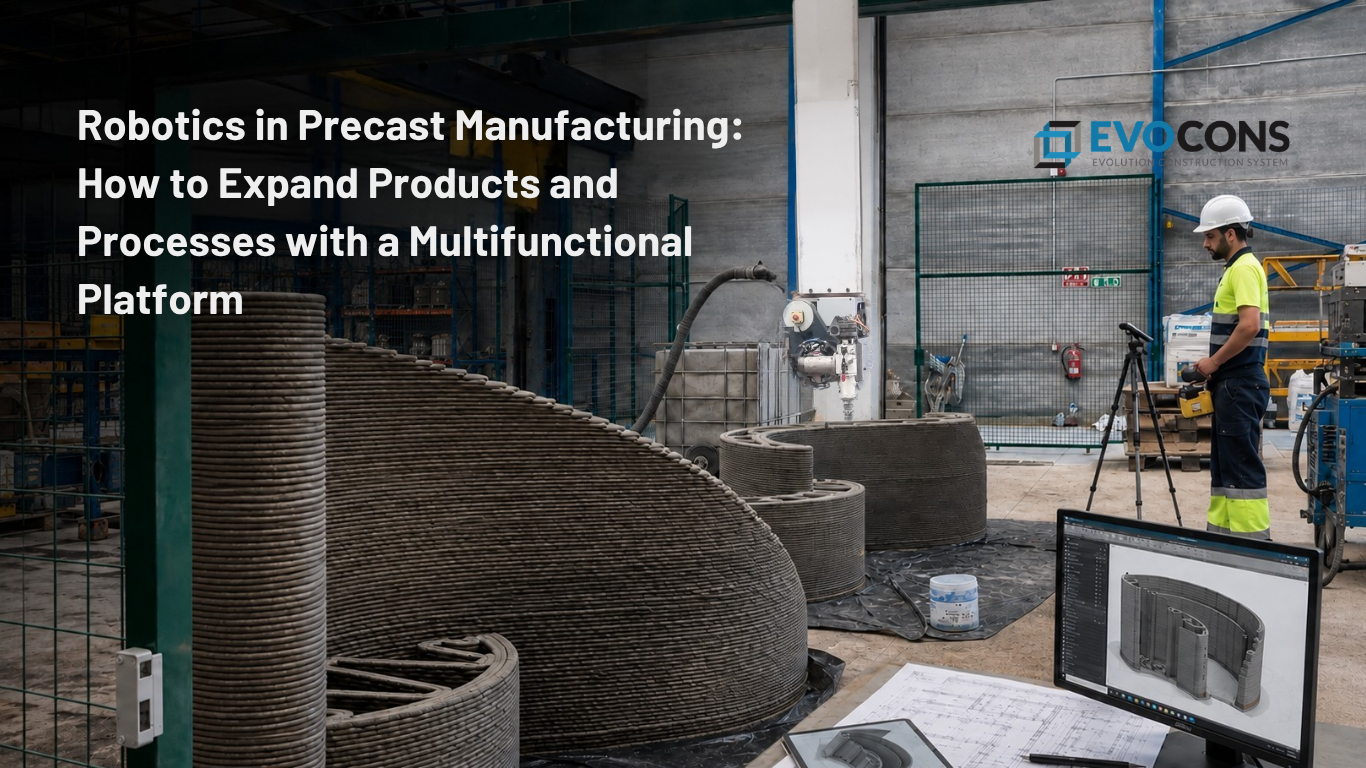
This multifunctional approach enables the platform to support a wide range of construction activities, from additive manufacturing and structural element production to automated finishing operations and prefabrication workflows.
Its inclusion in the PTEC Yearbook illustrates a broader trend within the industry: innovation increasingly depends on platforms capable of integrating several technologies rather than addressing isolated tasks.
For this reason, multifunctional robotic systems are becoming one of the most promising directions for the future of construction automation.
A Collaborative Innovation Ecosystem
Beyond showcasing individual technologies, the PTEC 2025 Yearbook highlights another key factor driving transformation in the construction industry: collaboration.
Innovation in construction is no longer developed in isolation. Instead, it results from cooperation between construction companies, technology providers, universities, research centers and public institutions working together to accelerate the adoption of new solutions.
This collaborative approach enables research outcomes to move beyond laboratories and into real-world construction projects, facilitating technology transfer and supporting the development of practical applications capable of addressing industry challenges.
The diversity of organizations represented throughout the Yearbook illustrates the strength of Spain’s construction innovation ecosystem and demonstrates that meaningful technological progress depends on multidisciplinary collaboration.
Innovation as a Driver of Competitiveness
Construction is entering a new era where digital technologies are becoming fundamental tools for improving productivity, quality and sustainability.
The projects featured in the PTEC 2025 Yearbook demonstrate that technologies such as construction robotics, artificial intelligence, additive manufacturing, automation and industrialized construction are no longer isolated concepts. They are becoming strategic components of the industry’s ongoing transformation.
Within this context, the inclusion of Evoconstructor® among the robotics initiatives reflects Evocons’ contribution to the development of advanced technologies for construction process automation and reinforces the company’s commitment to delivering innovative solutions for Construction 5.0.
More importantly, its presence highlights a broader industry trend: the future of construction will increasingly rely on integrated technological platforms capable of combining robotics, digitalization and intelligent manufacturing into scalable, real-world applications.
Conclusion
The PTEC 2025 Yearbook provides valuable insight into one of the most dynamic periods of technological transformation the construction industry has experienced in decades.
By bringing together innovative projects from across Spain and Europe, the publication demonstrates that digital transformation is no longer a future ambition, it is already reshaping the way buildings and infrastructure are conceived, designed and delivered.
Robotics, artificial intelligence, additive manufacturing, industrialized construction and digital technologies are no longer developing independently. Instead, they are converging to create more connected, efficient and sustainable construction processes capable of meeting the evolving needs of the industry.
Equally significant is the collaborative ecosystem represented throughout the Yearbook. Construction companies, universities, technology centers and public institutions are working together to accelerate innovation, validate emerging technologies and transform research into practical solutions with measurable impact.
Within this broader landscape, construction robotics is evolving from a promising technology into a strategic capability. Robotic platforms are increasingly supporting construction automation, digital manufacturing, prefabrication and intelligent production workflows that improve precision, flexibility and operational efficiency.
The inclusion of Evoconstructor® in the robotics chapter of the PTEC 2025 Yearbook reflects this technological evolution. More than an individual recognition, it illustrates how multifunctional robotic systems integrating artificial intelligence, automation and additive manufacturing are becoming part of a wider movement driving the modernization of construction.
For construction companies, developers, public authorities, manufacturers and research organizations, the message is clear: understanding these technologies is no longer simply about anticipating the future—it is about identifying the capabilities that will define competitiveness in the years ahead.
The PTEC 2025 Yearbook serves as an important reference for anyone seeking to understand how innovation is transforming construction and which technologies are helping shape a more digital, automated, industrialized and sustainable industry.