Construction robotics safety begins before a robotic system starts operating. It starts with process design, hazard identification and a clear definition of how people, machines, materials and digital systems will interact.
Robotic systems can automate selected repetitive or physically demanding operations. This allows construction professionals to focus on supervision, planning, technical control, quality and specialized tasks while the system performs programmed, repeatable and monitorable movements.
A robust construction robotics safety strategy does not assume that automation eliminates every risk. It integrates technology into a broader preventive approach based on risk assessment, controlled operating areas, professional training, maintenance and measurable performance.
This approach connects robotics and occupational risk prevention with one of the central principles of Construction 5.0: using advanced technology to create more controlled, precise and people-centred construction processes.
Spanish version: Seguridad laboral en construcción robotizada: cómo elevar los estándares en obra
What is construction robotics safety?
Construction robotics safety is the coordinated set of design measures, technologies, procedures and controls used to integrate robotic systems into construction environments.
It covers the complete lifecycle of the robotic application:
- Process and system design.
- Risk assessment.
- Installation and commissioning.
- Programming and trajectory verification.
- Access control.
- Normal operation.
- Tool changes.
- Cleaning and maintenance.
- Alarm recovery.
- Emergency stopping.
- Performance monitoring.
Safety cannot be assessed by analysing the robot alone. The assessment must also consider its tools, pumping systems, materials, energy sources, auxiliary structures, operating environment and other activities taking place nearby.
The NIOSH Center for Occupational Robotics Research studies the safety, health and wellbeing of people who use robots, work alongside them or interact with robotic systems.
For this reason, construction robotics safety must address the complete process rather than treating the robot as an isolated machine.
Why construction robotics safety matters
Robots can perform programmed movements with precision and consistency. In construction, this can reduce the need for direct intervention during selected repetitive or physically demanding operations.
It may also limit the time people need to spend close to certain automated movements during an operating cycle.
NIOSH examines this potential in its publication “Transforming Construction: Automation and Robotics for a Safer Future”, which explores how automation and robotics can support safer construction processes.
However, the presence of a robot does not automatically make a construction site safer.
For construction robotics safety to produce measurable value, automation must be integrated into:
- The project risk assessment.
- The health and safety plan.
- The construction method.
- The site layout.
- Access and authorization procedures.
- Equipment coordination.
- Professional training.
- Maintenance procedures.
- Emergency protocols.
The European Agency for Safety and Health at Work explains that advanced robotics can transform how tasks are designed and performed. This creates preventive opportunities while also requiring careful management of human–robot interaction.
When properly planned, construction robotics safety can support:
- Physical separation from selected operations during automatic execution.
- Reduced direct intervention in repetitive movements.
- Stable and verifiable work sequences.
- Real-time monitoring of operating parameters.
- Controlled access to robotized areas.
- Traceability of stops, alarms and interventions.
- Continuous improvement based on operational data.
Robotics and occupational risk prevention by design
The main contribution of robotics is not simply the mechanization of one task. It also creates an opportunity to redesign the construction process around preventive criteria.
In a robotized workflow, teams can define the following elements before execution begins:
- Trajectories.
- Speeds.
- Tools.
- Operating areas.
- Work sequences.
- Entry procedures.
- Stop functions.
- Maintenance operations.
This planning helps teams anticipate how the robot, construction professionals, materials and the surrounding environment will interact.
The relationship between robotics and occupational risk prevention supports prevention through design. The objective is to identify potential hazards and introduce control measures during the engineering and planning stages instead of relying only on later corrective action.
ISO 12100:2010 establishes principles and a methodology for machinery risk assessment and risk reduction during design.
ISO 10218-1:2025 addresses safety requirements for industrial robots, while ISO 10218-2:2025 focuses on the integration of robot applications and robot cells.
The specific applicability of these standards to a construction system must be determined through a dedicated technical and regulatory assessment.
A stronger hierarchy of controls
Automation can support preventive measures that act before personal protective equipment becomes the primary control.
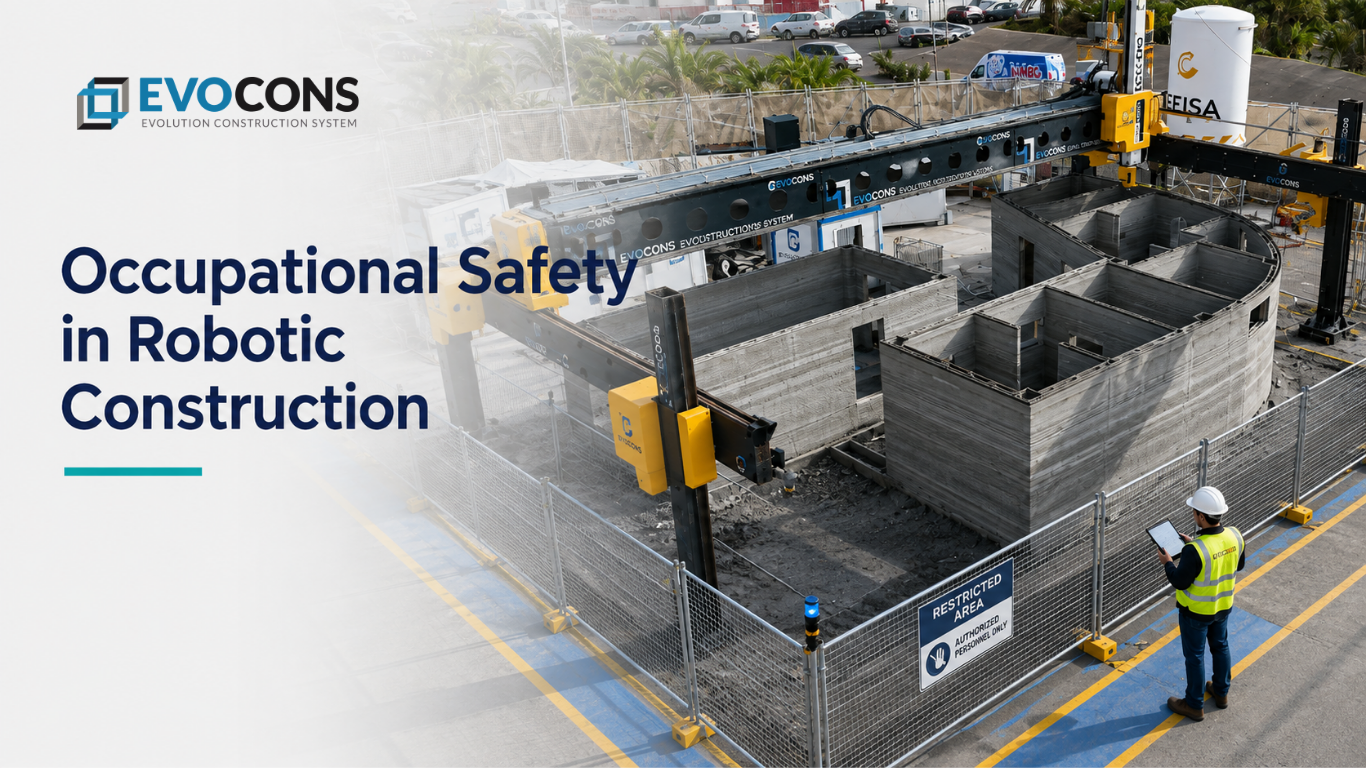
When an operation is performed inside a clearly delimited robotized area, the need for direct presence next to moving equipment may be reduced during the automatic cycle.
The risk does not disappear. It must be managed through measures such as:
- Safe system design.
- Physical barriers.
- Fencing.
- Safety scanners.
- Proximity sensors.
- Warning lights and audible signals.
- Access control.
- Verified safety distances.
- Emergency-stop functions.
- Energy-isolation procedures.
The correct combination depends on the task, the operating environment and the specific risk assessment.
This is how construction robotics safety moves from a reactive approach to prevention integrated into the process.
How a multifunctional construction robot strengthens construction robotics safety
A specialized robotic system normally automates one operation. A multifunctional construction robot can participate in several connected stages of the construction process.
This difference is important because fragmented automation may require separate control systems, interfaces, operating procedures and safety areas.
A multifunctional construction robot creates the possibility of coordinating several operations within one technological platform.
According to EVOCONS documentation, Evoconstructor® integrates four main functional areas:
- 3D printing of construction elements.
- Concrete pumping, pouring and levelling.
- Robotic tools for finishing operations.
- An automated self-elevation system for vertical progression.
These functions are also presented on the EVOCONS page dedicated to the Evoconstructor® multifunctional construction robot.
This multifunctionality can support a common approach to access control, start-up and shutdown, tool changes, maintenance and coordination with other equipment.
EVOCONS documentation also reports that 60% of the construction process was automated in a project completed in Agüimes in 2025.
This figure describes the operational scope reported by EVOCONS. It does not, by itself, demonstrate an equivalent reduction in incidents or exposure.
A preventive result must be demonstrated by comparing project-specific indicators before and after implementation.
Common procedures across several operations
When different tasks are integrated into the same platform, companies can establish common procedures for:
- Accessing the robotized area.
- Authorizing users.
- Starting and stopping the system.
- Changing tools.
- Isolating energy sources.
- Performing maintenance.
- Recovering after an alarm.
- Coordinating the robot with other equipment.
This integration may reduce unplanned transitions between independent systems, provided that every tool, material, energy source and configuration is included in the assessment.
Greater predictability of movements
Programmed trajectories make it possible to identify the robot’s expected operating envelope before work begins.
This predictability can support:
- Safety perimeter planning.
- Installation of barriers and signs.
- Configuration of detection systems.
- Trajectory verification.
- Definition of authorized access procedures.
- Coordination with nearby activities.
Programming must be reviewed whenever the geometry, terrain, tool, material or construction sequence changes.
Centralized supervision and traceability
A multifunctional platform can centralize information from several operations within a common interface.
For construction robotics safety, this can improve the traceability of:
- Operating status.
- User authorization.
- Alarms.
- Emergency stops.
- Automatic-cycle duration.
- Interventions.
- Maintenance activities.
Its effectiveness depends on the quality of the recorded data, the clarity of the interface and the procedures established by the integrator and user organization.
Evoconstructor® as a multifunctional construction robot
Evoconstructor® is a multifunctional construction robot designed to connect different stages of the construction process within a coordinated technological ecosystem.
Its ability to integrate 3D printing, concrete pumping, pouring, levelling, finishing and self-elevation supports the development of a connected digital workflow.
From a construction robotics safety perspective, this integration may facilitate:
- More structured planning.
- Greater predictability of movements.
- Common operating protocols.
- Centralized supervision.
- Improved traceability.
- Better coordination between tasks.
- Data-based preventive management.
- Development of specialized professional skills.
EVOCONS provides applications for Evoconstructor® in on-site construction, prefabricated production and research environments.
Its application in industrialized production can be explored further on the EVOCONS page about robotized prefabricated construction.
The objective is not to create construction environments without people. It is to develop processes in which professional expertise and technology work together with greater control, precision and visibility.
Evoconstructor® applications and potential preventive contributions
The following applications show how a multifunctional construction robot may contribute to construction robotics safety.
These are potential control mechanisms and must be validated for each project.
| Robotized application | Potential preventive contribution | Essential controls |
|---|---|---|
| On-site 3D printing | May reduce direct intervention close to the deposition area during the automatic cycle | Safety perimeter, access control, emergency stop and trajectory verification |
| Concrete pumping, pouring and levelling | May reduce selected repetitive operations and time spent close to automated movements | Pressure control, secure connections, pipeline inspection and energy isolation |
| Rendering, milling or polishing | May limit direct exposure during selected movements and improve repeatability | Dust, projection and noise assessment, local extraction and appropriate guarding |
| Insulation application | May automate part of the application process using programmed trajectories | Material control, ventilation, barriers and cleaning procedures |
| Automated self-elevation | May integrate vertical progression into a controlled automated workflow | Structural assessment, stability checks, inspections and exclusion zones |
| Robotized prefabrication | May support processes performed in more stable and organized environments | Separation of flows, component handling and safe maintenance |
The implementation must analyse both the possible preventive contributions and the risks introduced by the robotic system.
Five conditions for safe construction automation
Safe construction automation requires more than adding advanced machinery to a project. The technology must be integrated into the construction method and preventive planning.
1. Conduct a task-specific risk assessment
Every configuration, tool, material and stage of work must be assessed individually.
It is not enough to analyse the robot as an isolated machine. The assessment should also cover:
- Pumps and material-delivery systems.
- Electrical systems.
- Hydraulic systems.
- Finishing tools.
- Auxiliary structures.
- Travel paths.
- Nearby equipment.
- Environmental conditions.
2. Define and control the robotized area
Safe construction automation requires the robot’s operating envelope to be clearly identified and controlled.
Depending on the risk assessment, the solution may include:
- Physical barriers.
- Fencing.
- Safety scanners.
- Proximity sensors.
- Warning systems.
- Signage.
- User authorization.
The objective is to prevent or reduce unexpected entry during automatic operation.
3. Establish safe stopping and energy isolation
The system must include appropriate stopping functions and documented procedures for isolating all relevant energy sources before an intervention.
These may include:
- Electrical energy.
- Hydraulic pressure.
- Pneumatic pressure.
- Mechanical movement.
- Potential energy.
- Accumulated pressure in pumping systems.
Cleaning, maintenance, blockage removal and tool changes must form part of these procedures.
4. Train professionals and define responsibilities
Robotized construction creates opportunities for specialized roles in:
- Operation.
- Programming.
- Supervision.
- Maintenance.
- Quality control.
- Data management.
- Preventive coordination.
Each professional must understand their authorization level, operating limits, system signals and the required response to an alarm.
5. Monitor safe construction automation with data
Safe construction automation should produce indicators that show whether working conditions and process control are improving.
Without a baseline and subsequent monitoring, a preventive improvement cannot be attributed to robotization.
How to measure construction robotics safety
EVOCONS and the user organization should agree on indicators before robotic operation begins.
Recommended construction robotics safety indicators include:
- Hours of direct exposure to the automated task.
- Authorized entries into the robotized area.
- Interventions during automatic cycles.
- Emergency stops and preventive stops.
- Proximity and access alarms.
- Recorded incidents and preventive observations.
- Time spent performing repetitive movements.
- Duration of sustained postures.
- Compliance with energy-isolation procedures.
- Training hours by professional role.
- Completed preventive maintenance.
- System availability.
- Changes introduced into the health and safety plan.
- Team perceptions of control and ease of operation.
These indicators allow companies to move from a general statement—“robotics improves safety”—to a documented and verifiable conclusion for each project.
They can also help identify recurring alarms, unnecessary interventions, access patterns and opportunities for further process improvement.
Construction robotics safety within the Spanish regulatory framework
In Spain, construction robotics safety must be integrated into the preventive framework that applies to construction sites and work equipment.
Royal Decree 1627/1997 establishes minimum health and safety requirements for construction works.
The health and safety plan must develop preventive measures according to the planned construction system and should be adapted when the process, technology or operating conditions change.
Introducing a robotic system should therefore trigger a review of:
- Operating areas.
- Access procedures.
- Interaction with other equipment.
- Construction sequences.
- Emergency protocols.
- Maintenance processes.
- Professional training.
- Coordination between organizations.
The robot should be integrated into the preventive organization of the project rather than treated as an isolated additional tool.
Royal Decree 1215/1997 also requires employers to consider working conditions, workplace risks, risks arising from equipment and ergonomic principles.
The European Machinery Regulation 2023/1230 provides a further regulatory reference for machinery placed on the European Union market.
Construction 5.0 and occupational safety: technology centred on people
The relationship between Construction 5.0 and occupational safety is based on using automation to develop processes that are more controlled, measurable and centred on people.
Technology can expand professional capabilities in supervision, programming, digital manufacturing, maintenance, technical control and data management.
In this context, construction robotics safety becomes part of the process design rather than a later response to potential risks.
Evoconstructor® represents this approach by integrating several construction operations within one coordinated platform.
The combination of automation and professional expertise can support a more predictable, organized and traceable construction process.
The objective of Construction 5.0 and occupational safety is not to separate technology from people. It is to strengthen the way people and advanced systems collaborate.
Robotics and occupational risk prevention centred on people
Robotics and occupational risk prevention should evolve together.
Automation provides new tools for controlling selected exposures, but its effectiveness depends on planning, training, maintenance and preventive coordination.
Construction 5.0 places people at the centre of this transformation. Robotized systems create opportunities for professionals to expand their skills in supervision, programming, digital manufacturing, technical control and data analysis.
In this context, technology does not replace professional knowledge. It strengthens that knowledge and integrates it into processes that are more organized, measurable and predictable.
Conclusion: construction robotics safety as a design principle
Construction robotics safety can help raise preventive standards when it is integrated from the process-design stage.
A multifunctional construction robot expands this opportunity by connecting several operations within one technological platform.
In the case of Evoconstructor®, these operations include:
- On-site 3D printing.
- Concrete pumping, pouring and levelling.
- Robotic finishing tools.
- Automated self-elevation.
Risk assessment, area control, safe stopping, energy isolation, professional training, maintenance and measurement are the elements that can turn automation into a verifiable preventive improvement.
The connection between Construction 5.0 and occupational safety is therefore not simply about increasing automation. It is about combining technology, professional knowledge and robotics and occupational risk prevention to build with greater control, precision and attention to people.
Frequently asked questions about construction robotics safety
What is construction robotics safety?
Construction robotics safety is the coordinated set of design measures, risk assessments, procedures and controls used to integrate robotic systems into construction environments.
How are robotics and occupational risk prevention connected?
Robotics and occupational risk prevention are connected through process design, trajectory control, access procedures, energy isolation, professional training and measurable operating standards.
Does a construction robot eliminate every risk?
No. A robot can control selected exposures, but it may also introduce risks related to movement, tools, energy, maintenance and human–robot interaction.
What is a multifunctional construction robot?
A multifunctional construction robot is a system capable of performing several operations through integrated tools or modules within the same platform.
What processes can Evoconstructor® automate?
Evoconstructor® integrates on-site 3D printing, concrete pumping, pouring and levelling, robotic finishing tools and automated self-elevation.
What does safe construction automation require?
Safe construction automation requires risk assessment, area control, energy isolation, stopping functions, professional training, maintenance and performance monitoring.
Can Evoconstructor® be used for prefabrication?
Yes. EVOCONS provides applications in which Evoconstructor® forms part of a robotized process for prefabricated production.
How can construction robotics safety be measured?
It can be measured through exposure hours, access events, interventions, alarms, stops, incidents, maintenance records and professional training.
Strengthen construction robotics safety in your project
Discover how Evoconstructor® can integrate different automated operations into a more controlled, traceable and coordinated construction process.
Request a technical assessment from EVOCONS to identify automatable processes, implementation conditions and project-specific preventive requirements.
Rank Math SEO configuration
Primary focus keyword
construction robotics safety
Secondary keywords
occupational safety in constructionrobotics and occupational risk preventionmultifunctional construction robotsafe construction automationConstruction 5.0 and occupational safety
SEO title
Meta description
Explore how construction robotics safety and multifunctional robots support controlled, measurable and people-centred construction processes.
Recommended slug
construction-robotics-safety
Suggested excerpt
Construction robotics safety combines process design, risk assessment and automation. Discover how Evoconstructor® supports more controlled workflows.