Construction robotics implementation: What to assess before investing
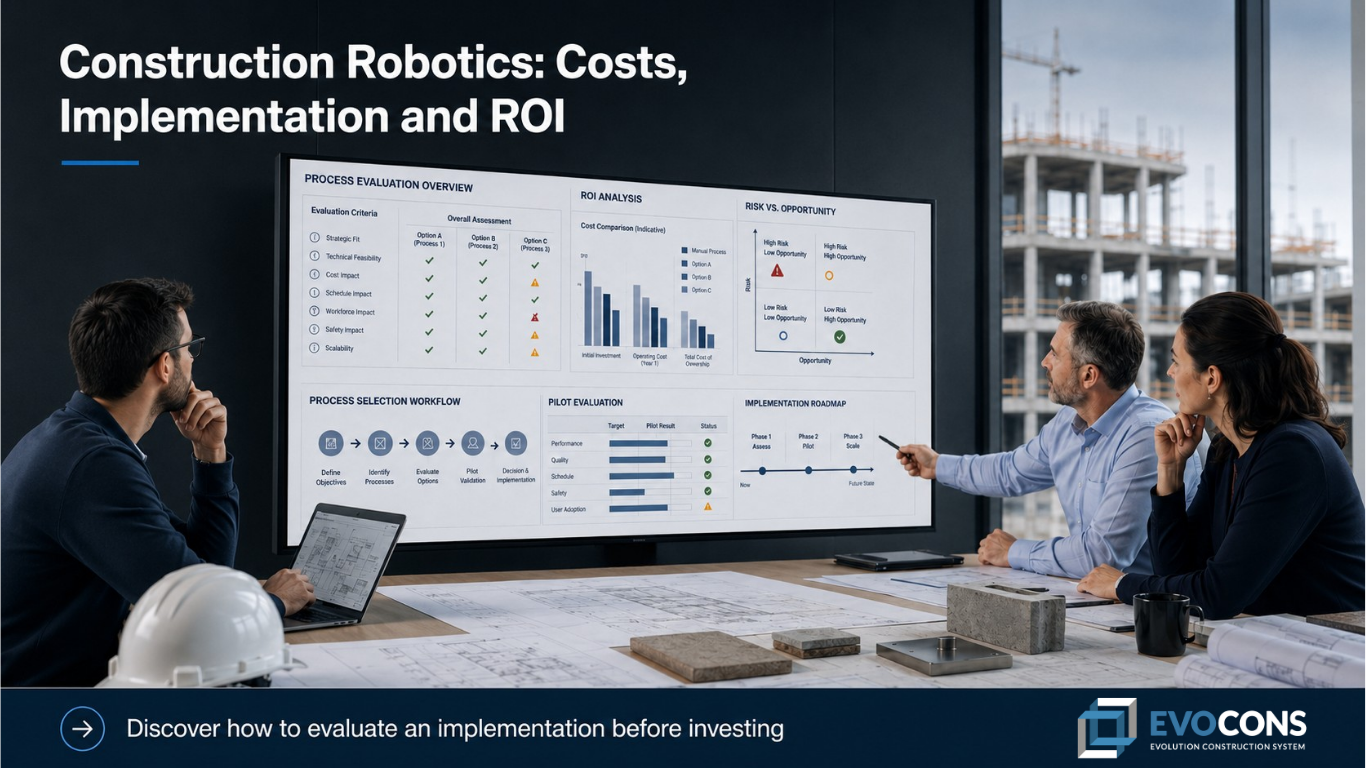
Implementing construction robotics is not simply a matter of purchasing equipment. It requires selecting a suitable process, establishing a baseline, calculating the full investment and defining indicators that can be compared before and after automation.
Return on investment, or ROI, relates the benefits generated to the capital allocated to the project. The payback period estimates how long it will take to recover that investment.
Both indicators depend on factors such as activity volume, system utilisation, materials, tools, technology integration, maintenance, quality and the ability to scale the application.
For contractors, developers and precast manufacturers, a structured strategy is to begin with a specific process, validate it through a measurable pilot and progressively expand its capabilities.
What does construction robotics implementation involve?
Implementing Construction Robotics means integrating an automated system into a construction or production process.
Installing the equipment is only one part of the project. Digital design, materials, tools, programming, quality control and operations must also be coordinated.
Depending on the scope, implementation may require:
- preparation of digital models;
- definition of paths and sequences;
- selection and characterisation of materials;
- tool configuration;
- integration with CAD, BIM or production software;
- system calibration;
- quality-control protocols;
- team training;
- maintenance and technical support;
- operational data collection.
An advanced system may generate limited value when applied to a poorly defined process. Conversely, a focused automation project can create measurable value when it addresses a specific operational requirement.
The academic paper A Simple Framework for the Cost–Benefit Analysis of Single-Task Construction Robots proposes evaluating each application according to its costs, productivity and potential benefits, rather than assuming that robotic automation will automatically be profitable.
For a broader introduction, see EVOCONS’ guide to robotics in construction.
ROI starts before selecting the robot
The first decision should not be which machine to acquire. It should be which process is worth transforming.
Before selecting a solution, five questions should be answered:
- Which operation should be improved?
- How is it currently performed?
- What time, cost and resources does it require?
- Which business outcome is expected?
- How will that outcome be measured?
These answers create the baseline needed to compare the current process with different automation scenarios.
The European Digital Innovation Hubs network documents the use of simulation within test-before-invest approaches.
These evaluations can compare configurations, anticipate integration requirements and estimate potential returns before physical investment begins.
When does it make sense to a construction robotics process?
Not every operation has the same level of compatibility with automation. Potential increases when the process is measurable, programmable and sufficiently stable.
A measurable baseline is available
Useful data may include:
- time per unit or cycle;
- output per hour or working day;
- material consumption;
- tolerances;
- incidents;
- auxiliary operations;
- preparation time;
- product changes;
- items requiring adjustment;
- direct and indirect costs.
Sufficient utilisation is expected
The investment is distributed across operating hours, units produced or projects completed.
High utilisation can support a shorter payback period. Automation can also create value in short or customised series when different geometries can be produced without developing a dedicated mould for every reference.
Precision and repeatability create value
Robotic systems can follow programmed paths and parameters.
This can be relevant when the process requires control over:
- geometry;
- position;
- thickness;
- flow rate;
- speed;
- distance;
- sequence;
- surface finish.
Variability can be managed digitally
Possible applications include:
- customised components;
- variable panels;
- façade elements;
- urban furniture;
- formwork;
- singular pieces;
- prototypes;
- short production runs;
- project-specific elements.
A scaling roadmap exists
The first application should be assessed as part of a planned progression:
automate → measure → validate → optimise → scale
How to establish the project baseline
The baseline describes current performance before automation is introduced.
| Variable | Information to record |
| Preparation | Design, programming, tooling and calibration |
| Execution | Operating time, speed and cycle duration |
| Materials | Consumption, surplus and auxiliary materials |
| Quality | Tolerances, corrections and non-conformities |
| Operations | Stops, tool changes and incidents |
| Logistics | Transport, handling and storage |
| Maintenance | Inspections, spare parts and support |
| Capacity | Units, metres or cycles per period |
Comparisons should use equivalent units, such as:
- cost per component;
- cost per linear metre;
- cost per square metre;
- cost per cubic metre;
- cost per cycle;
- cost per product reference.
Which costs should be included?
The purchase price represents only part of the total investment.
Technology and auxiliary systems
- robot and structure;
- controllers;
- sensors;
- positioning systems;
- material-feeding equipment;
- pumping equipment;
- safety systems;
- communications infrastructure.
Tools and end effectors
- 3D-printing head;
- pouring system;
- levelling tool;
- milling tool;
- applicator;
- inspection system;
- finishing tool.
Engineering and integration
- programming;
- process adaptation;
- software connectivity;
- model preparation;
- path planning;
- testing;
- documentation;
- validation.
Installation and infrastructure
- transport;
- assembly;
- space preparation;
- electrical supply;
- material supply;
- pumping;
- networks;
- protection systems;
- commissioning.
Materials and testing
- formulation;
- pumpability;
- consistency;
- open time;
- geometry;
- adhesion;
- tool compatibility;
- behaviour of the produced element.
Training, maintenance and support
- operator training;
- programming training;
- quality-control training;
- preventive maintenance;
- spare parts;
- updates;
- technical support;
- internal project time.
How to calculate construction robotics ROI
The basic formula is:
ROI = (accumulated benefit − total investment) ÷ total investment × 100
Hypothetical ROI example
- total investment: €600,000;
- estimated annual net benefit: €200,000;
- assessment period: five years.
Accumulated benefit:
€200,000 × 5 = €1,000,000
Simple ROI:
(€1,000,000 − €600,000) ÷ €600,000 × 100 = 66.7%
This example is illustrative and does not represent the price or expected performance of a specific solution.
How to calculate the payback period
Payback = total investment ÷ annual net benefit
Using the previous example:
€600,000 ÷ €200,000 = 3 years
Payback can be combined with:
- ROI;
- net present value;
- internal rate of return;
- unit cost;
- utilisation;
- annual capacity.
Which benefits should be quantified?
Production capacity
- units per hour;
- metres completed;
- cycle time;
- annual capacity;
- availability;
- system utilisation.
Material utilisation
- material purchased;
- material incorporated into the product;
- surplus;
- rejected components;
- auxiliary materials;
- waste;
- correction operations.
Quality and consistency
- geometric deviation;
- components outside tolerance;
- variation between cycles;
- correction time;
- cost of non-conformities;
- claims.
Production flexibility
- new-product launch time;
- reference-preparation cost;
- number of geometries;
- moulds or tooling required;
- customised projects;
- revenue from new products.
Traceability and predictability
- planning;
- estimating;
- production control;
- deviation monitoring;
- documentation;
- decision-making.
Which KPIs should a pilot measure?
Productivity
- units per hour;
- metres completed;
- cycle time;
- preparation time;
- total time;
- availability;
- utilisation rate.
Quality
- geometric deviation;
- tolerances;
- homogeneity;
- accepted components;
- components requiring adjustment;
- repeatability.
Materials
- expected consumption;
- actual consumption;
- surplus;
- waste;
- auxiliary materials;
- variation between components.
Operations
- number of stops;
- causes of stops;
- calibration time;
- tool-change time;
- maintenance interventions;
- learning time.
Economics
- cost per unit;
- cost per metre;
- preparation cost;
- operating cost;
- value of additional capacity;
- mould or tooling cost;
- revenue from new references.
Sustainability
- energy use;
- material use;
- waste;
- transport;
- logistics distances;
- expected durability;
- comparison scenario.
How to use simulation before investing
Simulation can analyse:
- robot reach;
- accessibility;
- paths;
- operating times;
- possible interference;
- equipment layout;
- material feeding;
- tool changes;
- production capacity.
The case published by the European Digital Innovation Hubs used simulation to optimise a robotisation concept and anticipate implementation requirements.
On-site construction robotics implementation
On-site assessments should include:
- ground conditions;
- access;
- operating space;
- system movements;
- material supply;
- environmental exposure;
- project sequence;
- coordination with other processes.
The analysis should also include:
- transport;
- assembly;
- calibration;
- site preparation;
- dismantling;
- relocation.
Implementation in precast factories
Precast facilities offer:
- controlled environments;
- planned production;
- repeatable cycles;
- data availability;
- equipment integration;
- multiple product references.
The economic analysis should consider:
- volume;
- geometric variability;
- time per reference;
- mould cost;
- handling;
- storage;
- finishing;
- shift utilisation;
- capacity to develop new products.
For further detail, see the article on the industrialisation of precast production through robotics.
Specialised robot or multifunctional platform?
Specialised robot
It may be appropriate when:
- the product is stable;
- production volume is high;
- the operation changes little;
- the line is optimised;
- repetition distributes the investment.
Multifunctional platform
It may create more value when:
- several products are involved;
- geometries change;
- new applications are expected;
- multiple operations should be integrated;
- automation will evolve in phases;
- flexibility is part of the business model.
EvoConstructor® is developed as a multifunctional robotic platform for on-site construction and precast applications.
3D printing is one of its capabilities rather than the limit of the system. This distinction is explored in the guide to multifunctional construction robots.
How to interpret supplier metrics
Each indicator should be linked to:
- an application;
- a material;
- a geometry;
- a configuration;
- a reference scenario;
- a measurement period;
- a methodology;
- operating conditions.
A speed improvement does not automatically produce an equivalent reduction in total cost.
A reliable formulation is:
“The solution may achieve specific results depending on the application, configuration and project conditions. Each implementation should be validated through a dedicated technical and economic assessment.”
Construction robotics implementation roadmap
1. Process diagnosis
2. Application selection
3. Business-case definition
4. Simulation and preparation
5. Pilot project
6. Validation
7. Optimisation
8. Scaling
Quality and standards in additive construction
ISO/ASTM 52939:2023 specifies quality-assurance requirements for construction projects using additive manufacturing techniques.
Its use does not replace:
- design approval;
- material characterisation;
- relevant testing;
- national regulations;
- structural requirements;
- safety assessment.
EVOCONS provides a guide to ISO/ASTM 52939 for construction 3D printing.
Is construction-robot adoption growing?
The executive summary of World Robotics 2025, Service Robots, published by the International Federation of Robotics, identifies robots for construction and demolition as a niche market.
Each project must still be assessed according to its own:
- application;
- volume;
- integration;
- utilisation;
- quality requirements;
- cost;
- scaling potential.
Measure before scaling
The return from construction robotics begins before the system is installed.
It starts by identifying a process with a clear opportunity, creating a baseline and defining the outcomes to be achieved. It continues with a full cost assessment, simulation where applicable and a pilot that measures productivity, quality, materials, operations and economics.
Automation should not be treated as the isolated acquisition of a machine. It is a transformation strategy connecting design, materials, tools, software, execution and data.
For contractors, developers and precast manufacturers, the strongest approach is to advance through measurable applications, validation and progressive scaling.
Frequently asked questions about implementation and ROI
How is construction robotics ROI calculated?
Subtract total investment from accumulated benefit, divide the result by total investment and multiply by 100.
How long does a construction robot take to pay back?
It depends on the total investment and the net benefit generated.
Which processes should be automated first?
Measurable and programmable processes with sufficient utilisation.
Which KPIs should a pilot measure?
Productivity, cycle time, tolerances, material consumption, incidents, availability, unit cost and repeatability.
Is a specialised robot or multifunctional platform better?
It depends on the production model and the expected applications.
Does construction 3D printing guarantee a positive ROI?
No. Returns depend on the product, geometry, volume, materials, utilisation, integration and reference process.
Can ROI be estimated before installation?
Yes, using a baseline, simulation and financial scenarios. The result should then be validated through a representative pilot.
Which processes can EvoConstructor® address?
The platform is designed to use different tools for 3D printing, material application, pouring, levelling, machining and selected finishing operations, depending on configuration and project requirements.
CTA
Assess which process should be automated first
EVOCONS evaluates automation opportunities for on-site construction, precast production and digital manufacturing using EvoConstructor®.