Construction decarbonization requires looking beyond the energy consumption of buildings. It also means examining the materials we use, how they are manufactured and transported, how construction work is carried out, and what happens to those resources throughout their entire life cycle.
The scale of the challenge is significant. According to the Global Status Report for Buildings and Construction 2025–2026 by by UNEP and GlobalABC, the buildings and construction sector accounts for around 37% of global CO₂ emissions and nearly 50% of global material extraction.
In this context, construction process automation, robotics, and digital fabrication can provide new tools to improve precision, strengthen resource control, and generate the data needed to measure and optimize processes.
However, a technology is not low-carbon by definition. Its impact must be assessed by considering materials, energy, logistics, execution, and the full life cycle.
What Does Construction Decarbonization Mean?
Construction decarbonization means progressively reducing the greenhouse gas emissions associated with buildings and infrastructure throughout their life cycle.
This includes emissions related to the production and transport of materials, on-site construction activities, building operation, replacements and maintenance, as well as demolition, waste transport, reuse, recycling, and final disposal.
The European Union is moving precisely toward this whole-life-cycle approach.
The European framework establishes that life-cycle global warming potential will have to be calculated and disclosed from January 2028 for new buildings with a useful floor area above 1,000 m², and from January 2030 for all new buildings.
This reinforces a key idea: decarbonization is not only about building differently. We also need to measure how we build more effectively.
Embodied Carbon and Operational Carbon: Two Dimensions of the Same Challenge
To understand the climate footprint of a building, it is useful to distinguish between two concepts.
Operational Carbon
Operational carbon is mainly associated with emissions linked to the energy used during the building’s operational phase.
Energy efficiency, electrification, and the use of lower-carbon energy sources are some of the strategies related to this dimension.
Embodied Carbon
Embodied carbon refers to emissions associated with the materials and processes involved at different stages of the life cycle, including production, transport, construction, maintenance, replacement, and end of life.
This distinction is important because it broadens the conversation.
Decarbonization does not depend only on how a building performs once it has been completed. It also depends on which materials we use, where they come from, how we process them, and how we organize the construction process.
Decarbonization Also Means Improving the Way We Build
Materials play a fundamental role, but the way the construction process is organized and executed also creates opportunities for improvement.
Automation, digital fabrication, traceability, logistics planning, and circular economy principles can influence different variables:
| Variable | Potential impact | Improvement lever |
|---|---|---|
| Deviations and rework | Additional consumption of materials, energy, and time | Automation and digital control |
| Material use | Surplus and waste generation | Design and digital fabrication |
| Material origin and circularity | Transport, extraction of new resources, and waste management | Local, reused, recycled, or secondary materials when technically appropriate |
| Logistics | Transport of materials, equipment, and components | Planning and localized production |
| Process variability | Lower control and predictability | Robotization and standardization |
| Lack of data | Difficulty measuring and improving performance | Digitalization and traceability |
The circular economy in construction adds an especially relevant dimension: keeping materials and resources in use for longer, encouraging reuse and recycling, and reducing the need for new raw material extraction whenever possible.
The European Environment Agency highlights reuse, recycling, and the use of secondary raw materials as central elements of a more circular economy.
Local materials can also form part of this strategy when they are technically, legally, and environmentally appropriate.
Shorter transport distances can improve certain logistics-related variables, while the use of regional resources can also support more localized value chains.
However, local does not automatically mean low-carbon.
To understand the real impact, factors such as material composition, manufacturing processes, energy use, transport, durability, and performance across the full life cycle must also be considered.
How Can Automation and Robotics Contribute?
Construction automation brings elements of digital and industrial process control into different construction activities.
Its environmental contribution should not be assumed, but there are specific areas where it can create opportunities for improvement.
Precision and Resource Optimization
An automated process can perform specific tasks according to predefined digital parameters.
This can improve control over geometry, quantities, and tolerances, while reducing certain deviations during execution.
From a sustainability perspective, the most relevant relationship is:
Data → control → precision → measurement → optimization
Greater precision does not automatically translate into a specific reduction in CO₂ emissions, but it can create better conditions for measuring material use and comparing performance.
Digitalization and Traceability
One of the main advantages of automation is not only the ability to perform a task, but also the ability to generate information about the process.
Recording parameters, materials, consumption, time, or incidents provides valuable data that can help identify opportunities for improvement.
This level of traceability becomes increasingly important as regulation and market expectations move toward whole-life environmental assessment.
Multifunctional Robotics
Multifunctional robotics for construction introduces the possibility of integrating different operations within the same technological architecture.
Instead of treating automation as a sequence of separate machines dedicated to individual tasks, a multifunctional platform can connect different operations through software, interchangeable tools, and digital processes.
The potential value lies in integration: greater continuity between design and execution, increased process control, and better data generation throughout the construction workflow.
3D Printing, Local Materials, and the Circular Economy
3D printing in construction enables components to be manufactured through the controlled deposition of material based on a digital model.
This production method creates opportunities to adapt geometries, control material deposition, and manufacture specific elements according to the needs of each project.
It can also support research into formulations that incorporate regional resources or secondary raw materials, provided they meet the necessary technical and regulatory requirements.
The combination of digital fabrication, localized production, and locally available materials can be particularly relevant for circular economy strategies.
However, additive manufacturing should not automatically be considered more sustainable than conventional alternatives.
Its final environmental footprint depends on variables such as:
- material composition and quantity;
- origin of raw materials;
- energy consumption;
- design;
- transport and logistics;
- auxiliary equipment;
- durability and maintenance;
- reuse or recycling potential;
- the alternative scenario used for comparison.
For this reason, any claim regarding emissions reduction should be supported by data and a comparable life-cycle assessment methodology.
EvoConstructor®: Multifunctional Automation Applied to Construction
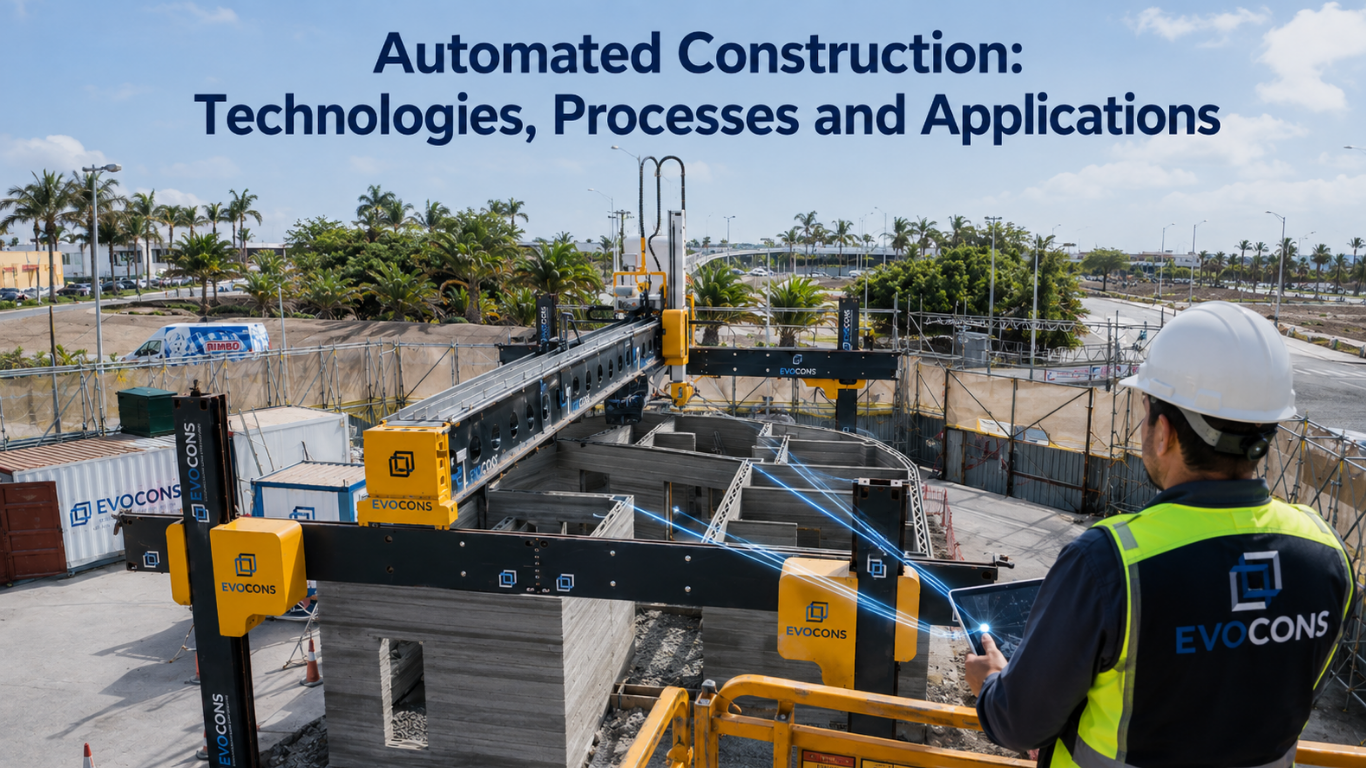
EVOCONS develops EvoConstructor®, an automated construction system that integrates software, robotics, artificial intelligence, and 3D printing and is designed for both in situ construction and prefabrication applications.
Its approach is based on multifunctionality.
Through different tools and associated systems, the platform can perform multiple construction operations, connecting digital fabrication and automation within a single technological architecture. EVOCONS’ public documentation includes, among other applications, 3D printing and tools for operations such as concrete pouring and selected finishing processes.
From a decarbonization perspective, the value of this model does not lie in assuming an automatic reduction in emissions, but in examining how greater integration can help control variables such as:
- material use;
- execution precision;
- planning;
- traceability;
- logistics;
- data generation.
In in situ construction, bringing certain production processes closer to the construction site also makes it possible to explore different logistics configurations and, where technically feasible, the use of regionally available resources.
In prefabrication, automation provides a particularly suitable environment for repetition, parameter control, and systematic process measurement. EVOCONS also considers EvoConstructor® for prefabricated construction applications.
The key is to measure each scenario and compare it with equivalent alternatives before attributing a specific climate benefit.
For a deeper analysis of additive manufacturing requirements in construction, EVOCONS also has a dedicated article on ISO/ASTM 52939, so this topic does not need to be covered in depth here. The current international standard is identified by ISO as ISO/ASTM 52939:2023.
Construction 5.0: Turning Data Into Better Decisions
Decarbonization does not depend on a single machine, material, or technology.
It requires a combination of design, materials, energy, logistics, digitalization, and execution from a whole-life-cycle perspective.
In this context, Construction 5.0 provides a framework for understanding automation, robotics, artificial intelligence, and digital fabrication as connected technologies within a broader construction process.
From an environmental perspective, one of the greatest opportunities lies in making a growing part of construction more measurable, controllable, and optimizable.
The question is no longer simply:
Can we automate this process?
We should also ask:
Can we measure it better so that materials, energy, and resources are used more efficiently?
The ability to turn data into better decisions is one of the keys to moving toward a more circular and lower-carbon construction industry.
Toward More Measurable, Circular, and Lower-Carbon Construction
Construction decarbonization requires action across the entire life cycle.
Lower-impact materials, circular economy principles, energy efficiency, and logistics are essential. But precision, traceability, and the ability to measure how resources are used are equally important.
Automation, robotics, and digital fabrication can contribute to this transformation when they improve process control and generate useful information for better decision-making.
The next step is not simply to automate more.
It is to ensure that technology enables us to build with a deeper understanding of how, where, and with which resources we are building.
Frequently Asked Questions About Construction Decarbonization
What Is Construction Decarbonization?
Construction decarbonization is the progressive reduction of greenhouse gas emissions associated with the life cycle of buildings and infrastructure, from materials and construction to operation and end of life.
What Is the Difference Between Embodied Carbon and Operational Carbon?
Operational carbon is mainly related to the energy used during building operation. Embodied carbon is associated with materials and processes such as production, transport, construction, maintenance, and end of life.
Can Automation Reduce the Carbon Footprint of Construction?
Automation can contribute to optimizing variables such as precision, resource use, traceability, and planning. Any specific reduction in emissions should be demonstrated using data and a methodologically consistent comparison.
Are Local Materials Always More Sustainable?
No. Shorter transport distances can reduce certain logistics-related impacts, but the total environmental impact also depends on how the material is manufactured, its composition, energy requirements, durability, and full life cycle.
What Is the Relationship Between the Circular Economy and Construction?
The circular economy aims to keep products and materials in use for longer through strategies such as reuse, recovery, recycling, and more efficient resource use.
Is 3D Printing Always More Sustainable Than Conventional Construction?
Not necessarily. Its environmental impact depends on materials, design, energy consumption, logistics, durability, and the alternative used for comparison.
Would You Like to Explore Which Processes in Your Project Can Be Automated?
Discover EvoConstructor® and explore how multifunctional robotics can be applied to in situ construction and prefabrication processes.