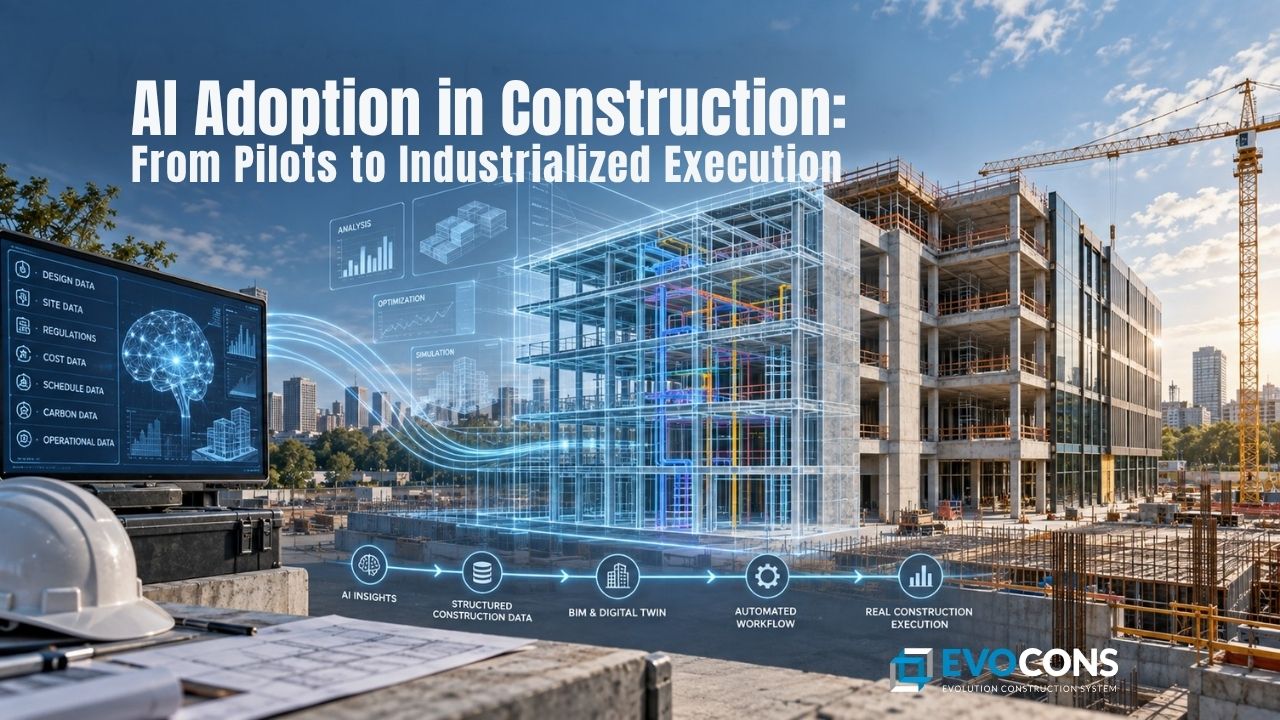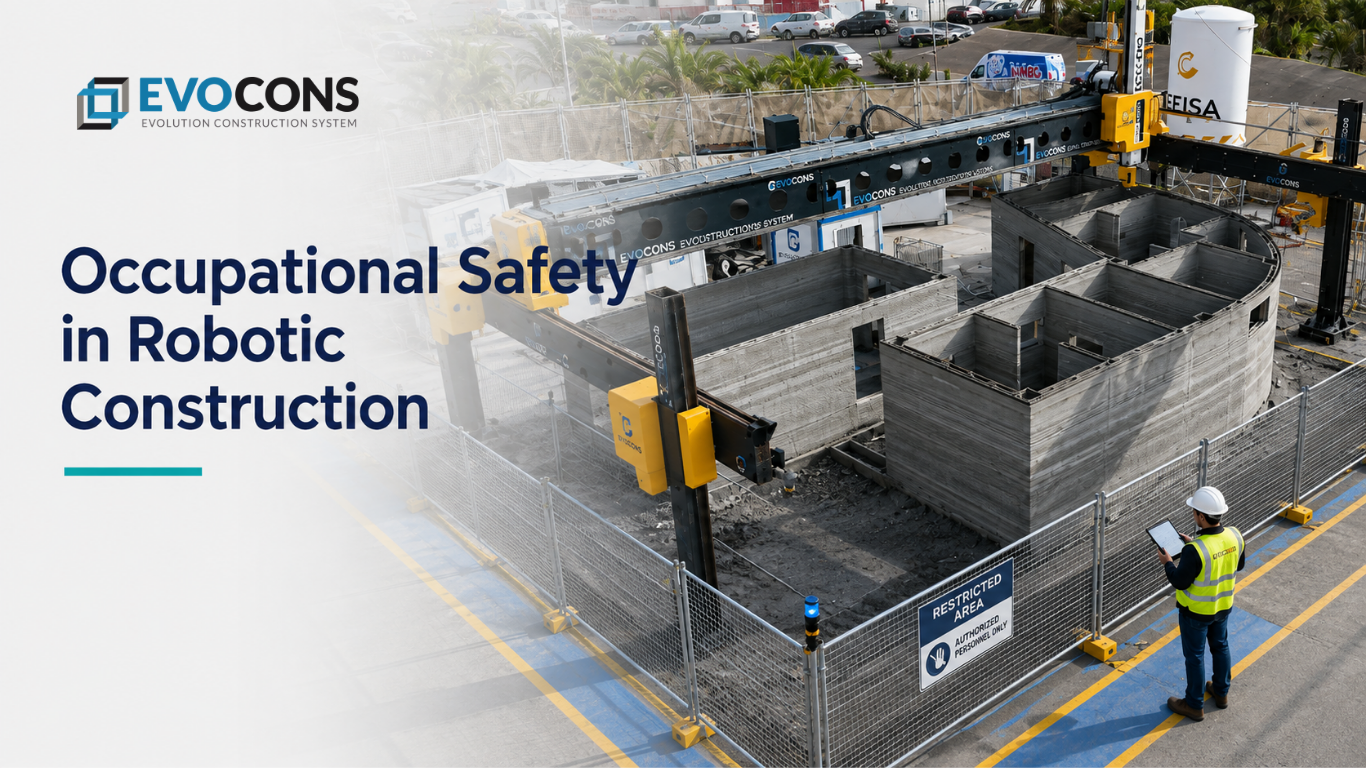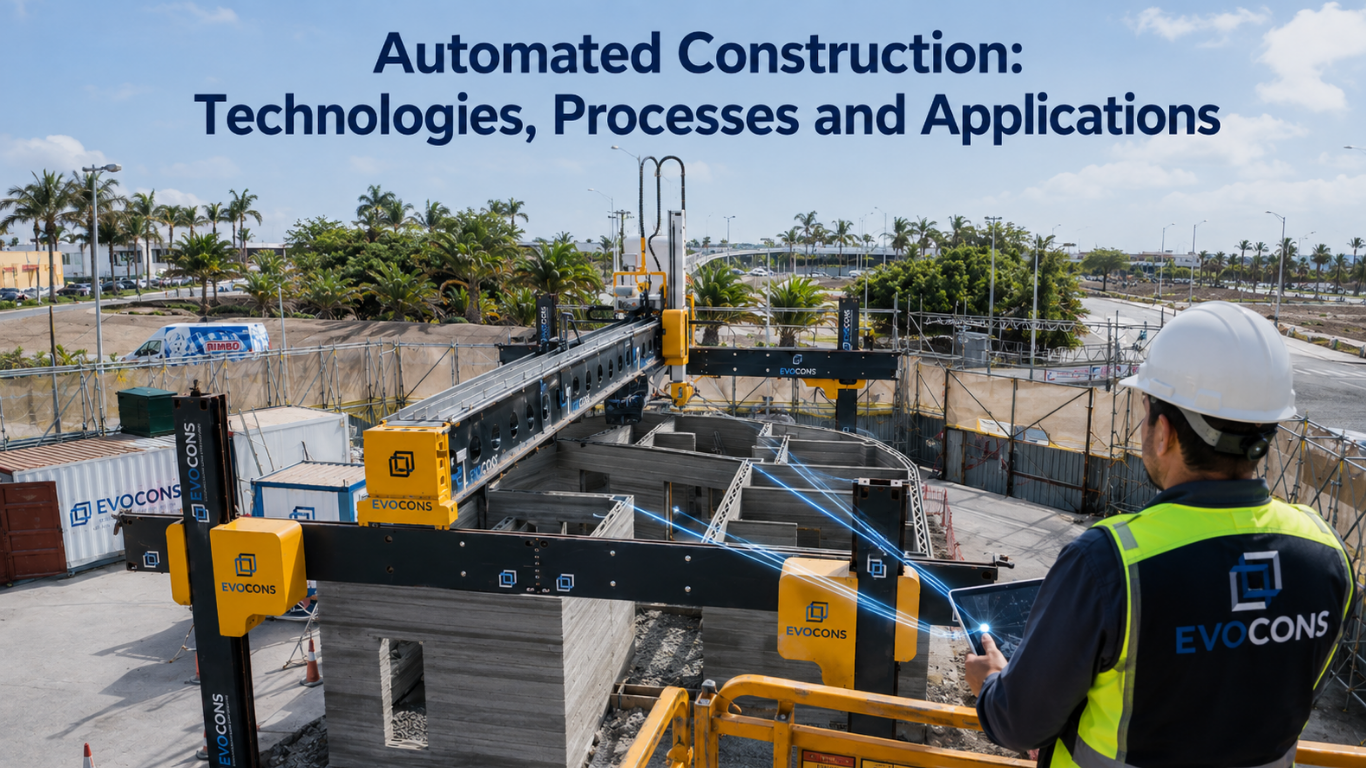
Automated construction uses robotics, software, artificial intelligence, BIM, sensors and 3D printing to execute and control processes in on-site construction and prefabrication.
It can be applied to a specific operation or integrate several tasks within a shared technological architecture. For contractors, developers and precast manufacturers, it creates new opportunities for precision, repeatability, traceability and process control.
EvoConstructor® represents this multifunctional approach by combining different tools and construction operations within a single platform.
What is automated construction?
Automated construction is a model that uses digital systems and programmable equipment to execute and control specific stages of the construction process, either partially or extensively.
It can integrate technologies such as:
- construction robotics;
- 3D printing and additive manufacturing;
- planning and control software;
- CAD and BIM models;
- artificial intelligence;
- sensors and monitoring systems;
- machine vision;
- automated prefabrication;
- data recording and traceability.
Automation does not necessarily mean that an entire project operates autonomously. It can be applied to one specific task or coordinate several operations within a planned workflow.
| Element | Role in the automated process |
| Digital model | Defines project geometries and information |
| Software | Prepares parameters, sequences and instructions |
| Robotic system | Performs programmed operations |
| Tools | Deposit, pour, apply or machine materials |
| Sensors | Record equipment, environmental and execution variables |
| Data | Supports control, traceability and analysis |
Automating one task is not the same as automating the entire process
Construction automation can be implemented at different levels.
Digitalisation
Project information is created and managed digitally, although physical execution may continue through separate equipment and systems.
Automation of a single operation
A machine performs a specific task based on programmed instructions.
A construction 3D printer, for example, primarily focuses on the controlled deposition of material to produce an element from a digital model.
Multifunctional automation
A multifunctional system can use different tools and coordinate several operations within a shared technological architecture.
The workflow can be represented as:
digital design → instructions → execution → data recording → control
The difference is not only the number of tasks performed. It also lies in the ability to share software, parameters and control systems across different operations.
From industrialised construction to Construction 5.0
Industrialised construction introduces standardisation, advance planning, controlled production and prefabrication.
Automated construction adds programmable equipment, robotics, software and the ability to record information during execution.
Construction 5.0 places these technologies within a broader framework based on sustainability, resilience and human-centricity.
| Model | Main characteristic |
| Conventional construction | Coordination of disciplines and sequential stages |
| Industrialised construction | Standardisation and controlled production |
| Automated construction | Execution through digital and programmable systems |
| Construction 5.0 | Technology integrated with sustainability, resilience and human-centricity |
The European Commission presents Industry 5.0 as an approach that complements industrial efficiency with sustainability, resilience and human wellbeing. This framework provides a conceptual reference for the development of Construction 5.0.
Key technologies in automated construction
Construction automation does not depend on a single technology. Its potential increases when different systems operate within a coordinated workflow.
Construction robotics
Construction robotics uses programmable equipment capable of following predefined paths, sequences and parameters.
Depending on the system and its configuration, it can support:
- 3D printing;
- material deposition and application;
- concrete pouring;
- levelling;
- machining;
- milling;
- rendering;
- tiling;
- polishing;
- insulation application;
- inspection and monitoring.
Some robots specialise in a single task. Others use interchangeable tools to expand the range of operations they can perform.
For a deeper analysis, read EVOCONS’ article on construction robotics: applications and benefits.
3D printing in construction
Construction 3D printing produces elements through the controlled deposition of material according to a digital model.
Its potential applications include:
- complex geometries;
- customisation;
- controlled toolpaths;
- digital manufacturing;
- geometric adaptation;
- reduced dependence on dedicated moulds in certain applications.
However, 3D printing and automated construction are not the same concept.
3D printing primarily automates a manufacturing operation. Automated construction can incorporate this operation together with other tools, tasks and control systems.
EVOCONS explores this distinction in greater detail in its guide to 3D printing in construction: benefits and limitations.
BIM, CAD and digital models
CAD and BIM models organise information related to geometries, materials, elements, coordination, planning and documentation.
For this information to be used by a robotic system, it must be converted into instructions compatible with the equipment, software and intended operation.
This digital continuity can support coordination between design and execution when appropriate preparation, validation and control processes are in place.
Artificial intelligence
Artificial intelligence can support areas such as:
- data analysis;
- anomaly detection;
- machine vision;
- planning;
- path optimisation;
- incident classification;
- quality-control assistance.
A distinction should be made between functions already implemented, applications under validation and future possibilities. The use of AI does not remove the need for defined parameters, technical supervision or acceptance criteria.
Sensors and monitoring
Sensors can record variables from the system, the environment or the execution process.
Depending on the configuration, they may document:
- time;
- position;
- speed;
- temperature;
- pressure;
- quantities;
- interruptions;
- incidents;
- production parameters.
These data can support traceability and the analysis of future improvements.
Construction robotics is attracting growing investment
Construction robotics is moving beyond pilot projects towards greater deployment, investment and integration into real operations.
According to the Construction Robotics Report 2026 by Zacua Ventures, specialised companies raised $1.36 billion during the first three quarters of 2025, 125% more than the $612 million recorded during the whole of 2024. This represented approximately 37% of the capital invested in construction technology during that period.
Investment momentum continued in 2026 through major funding rounds aimed at developing and deploying technologies capable of automating construction processes. Notable transactions included the $270 million raised by Bedrock Robotics, the $115 million announced by TerraFirma and the $32 million secured by Monumental.
Although these companies work with different technologies and applications, the transactions follow a shared direction: expanding the development, deployment and commercial scale of solutions that participate directly in the physical execution of construction.
Together, the data reveal two clear signals:
- more capital is being directed towards construction robotics and automation;
- solutions designed for integration into real workflows and scalable deployment are gaining relevance.
Automated construction is therefore entering a particularly favourable period, supported by greater access to capital, more mature technologies and a growing number of applications. For contractors, developers and precast manufacturers, this environment creates an opportunity to update processes, introduce new capabilities and take an active position in the evolution of Construction 5.0.
How does an automated construction system work?
Although each application requires a specific configuration, an automated construction process usually consists of five stages.
1. Digital design and definition
The process begins with digital project information.
This stage may define:
- geometries;
- dimensions;
- materials;
- tolerances;
- sequences;
- execution conditions;
- acceptance criteria.
2. Process planning
The design must be converted into a production strategy.
This involves defining:
- operation sequence;
- toolpaths;
- speeds;
- tools;
- accessibility;
- material supply;
- cycle times;
- control points.
3. Conversion into instructions
Software converts the prepared information into instructions the system can interpret.
These instructions may include movements, speeds, pauses, quantities, tool changes and parameters specific to each operation.
4. Automated execution
The robotic system performs the programmed tasks.
Depending on the solution, it may support printing, material application, pouring, levelling, machining, finishing or monitoring operations.
5. Control and traceability
Recorded data make it possible to compare the planned process with the completed operation and document relevant variables.
For a more detailed explanation, read about the stages of an automated construction process, from digital design to on-site execution.
Which construction processes can be automated?
Feasibility depends on the operation, materials, working environment, production volume and level of repeatability.
Manufacturing and material application
- 3D printing;
- material deposition;
- production of construction elements;
- coating application;
- execution of programmed geometries.
Structural operations
- automated pouring;
- levelling;
- execution of certain formwork solutions;
- operations associated with predefined structural elements.
Finishing operations
Specific tools and configurations can support or be developed for applications such as:
- rendering;
- milling;
- polishing;
- tiling;
- insulation application;
- surface treatments.
Inspection and control
Automation can also support:
- monitoring;
- data capture;
- geometric checks;
- parameter recording;
- incident documentation.
On-site automated construction
On-site automation brings the robotic system into the project execution environment.
This model may be appropriate when the objective is to:
- manufacture close to the point of installation;
- produce geometries adapted to the project;
- control specific operations;
- record execution parameters;
- coordinate the system with the construction sequence.
Installation planning should consider available space, ground conditions, access, materials, supply requirements and coordination with other activities.
Automated prefabrication
Precast factories provide conditions that are particularly compatible with automation:
- controlled environments;
- continuous production;
- repeated operations;
- planned production cycles;
- data availability;
- parameter control;
- equipment integration.
The combination of robotics and digital manufacturing can also support flexible prefabrication, allowing different geometries to be produced within the same automated workflow.
| Variable | Key question |
| Volume | How many units or metres will be produced? |
| Variability | Are the geometries identical, similar or different? |
| Cycle | How long does each operation currently take? |
| Material | Has it been validated for the proposed process? |
| Integration | Which equipment and software must be connected? |
| Quality | Which tolerances and controls are required? |
| Utilisation | How many productive hours will the system operate? |
Read more about the industrialisation of precast production through robotics.
Benefits of construction automation
Results depend on the system, automated process, working environment and reference scenario.
Benefits should therefore be expressed through verifiable indicators.
Precision and repeatability
A programmable system can follow predefined parameters and repeat sequences under controlled conditions.
This makes it possible to assess:
- geometric deviations;
- tolerances;
- quantities;
- toolpaths;
- consistency between cycles.
Control and traceability
Data recording can document execution variables and show the conditions under which an operation was completed.
Integration between design and execution
Digital continuity between the model, instructions and execution can support the monitoring of planned operations.
Its effectiveness depends on data preparation, system compatibility and the controls in place.
Geometric flexibility
Digital manufacturing can produce variations without always requiring a dedicated mould for each design.
This is particularly relevant for flexible prefabrication, customised elements and production series with geometric variations.
Measurement and continuous improvement
Automation can generate comparable information across production cycles.
These data can be used to analyse:
- time;
- consumption;
- interruptions;
- incidents;
- productivity;
- quality;
- system utilisation.
When does it make sense to automate a construction process?
Not every process has the same level of compatibility with automation.
High-affinity scenarios
- repeatable and measurable operations;
- continuous production;
- precision requirements;
- geometries based on digital models;
- processes requiring traceability;
- prefabrication environments;
- activities with defined parameters;
- projects supported by established digital planning.
Scenarios requiring prior assessment
- projects without production continuity;
- materials not yet characterised for the application;
- operations with unstructured variability;
- facilities requiring adaptation;
- processes not yet documented;
- integrations requiring specific development.
Implementation should begin by identifying a specific application, establishing baseline indicators and defining the intended measurable outcome.
How should an automation investment be assessed?
Feasibility depends on the process, activity volume, expected utilisation, materials, technology integration and project conditions.
The assessment may consider production capacity, cycle times, material consumption, precision, maintenance and continuity of use.
For further analysis, read EVOCONS’ article on construction robotics and the return on automation.
Automation and sustainability
The sustainability of an automated solution should be assessed by considering:
- materials;
- energy;
- logistics;
- quantities;
- waste;
- maintenance;
- transport;
- durability;
- life cycle.
Automation can provide data for monitoring consumption and comparing production configurations, but any claim about emissions or resource reductions should be supported by a defined methodology.
EVOCONS explores this topic in its analysis of decarbonising construction through automation and robotics.
EvoConstructor®: multifunctional construction robotics
EVOCONS develops EvoConstructor®, an automated construction system that integrates software, robotics, artificial intelligence, 3D printing and tools for different construction operations.
Its applications include processes related to:
- 3D printing;
- concrete pouring;
- levelling;
- selected finishing operations;
- on-site construction;
- precast production.
Unlike a system dedicated exclusively to material deposition, EvoConstructor® is designed as a multifunctional platform capable of using different tools within a shared technological architecture.
For further information, read about the multifunctional robot for construction.
Automated construction in real projects
Physical tests and projects make it possible to assess materials, system preparation, interaction between operations, tolerances and real execution conditions.
EVOCONS has developed prototypes and applications in Gran Canaria involving 3D printing, robotics and construction-process automation. Its corporate dossier includes a pilot house developed in 2023 and a project completed in Agüimes in 2025.
Each case study should transparently document:
- project scope;
- system used;
- automated operations;
- materials;
- surface area or dimensions;
- measured indicators;
- date and location.
Standards for additive construction
ISO/ASTM 52939:2023, Additive manufacturing for construction — Qualification principles — Structural and infrastructure elements, establishes qualification principles and quality-assurance requirements for additive manufacturing processes used in construction.
Its scope covers quality-relevant characteristics and activities performed within an additive manufacturing cell or construction environment. It does not replace design approval or independently cover every aspect of material characterisation.
EVOCONS also provides a dedicated article on ISO/ASTM 52939 and its application to construction 3D printing.
Frequently asked questions about automated construction
What is automated construction?
Automated construction uses robotics, software and digital systems to execute and control manufacturing, on-site or prefabrication operations. It may involve one specific task or several coordinated operations.
Which construction processes can be automated?
Depending on the system, printing, material deposition, pouring, levelling, machining, finishing, inspection and monitoring can be automated.
Is automated construction the same as 3D printing?
No. 3D printing primarily automates material deposition. Automated construction can combine 3D printing, robotics, software, sensors and other construction operations.
What is the difference between a 3D printer and a multifunctional robot?
A 3D printer specialises in manufacturing through material deposition. A multifunctional robot can use different tools and perform several operations within a shared architecture.
Can automation be used in precast production?
Yes. Precast environments support process programming, repetition, measurement and control.
What should be assessed before investing?
The assessment should consider the target process, expected production, materials, utilisation, integration, maintenance and the indicators used to compare results.
How much does an automated construction system cost?
The cost depends on dimensions, tools, process requirements, integration, materials, expected capacity and installation conditions.
Which standards apply?
Applicable requirements depend on the country, project, materials and intended use. For additive construction, ISO/ASTM 52939:2023 provides specific qualification principles.
The next step for automated construction
Automated construction is expanding the number of processes that can be executed, monitored and documented through programmable systems.
For contractors, developers and precast manufacturers, the first step is to identify a specific application, establish baseline indicators and assess which technology configuration best fits the project.
EVOCONS develops EvoConstructor® to apply multifunctional robotics in both on-site construction and prefabrication environments.
Discover which processes can be automated with EvoConstructor®.