Industrialized housing tenders are creating new opportunities for construction companies looking to participate in public housing projects through more efficient, digitally integrated and carefully planned building processes.
Across Spain, public authorities in Madrid, Valencia, Galicia and the Canary Islands are incorporating industrialized construction methods into residential developments. These initiatives are opening opportunities for companies capable of coordinating design, manufacturing, logistics and on-site execution.
But where can construction companies find these tenders? What requirements must they meet? And how can robotics and 3D printing contribute to industrialized housing projects?
This guide explores real examples from 2026, explains the main requirements for contractors and examines how construction automation can support the development of industrialized housing.
Industrialized Housing Tenders: Key Takeaways
Industrialized housing tenders are public procurement procedures for residential projects that incorporate industrialized construction methods. In Spain, several public authorities are advancing these approaches to support housing development and more coordinated building processes.
Examples include a €100.09 million tender in Madrid, two projects totaling 88 homes in Valencia, and a Galician program announcing 392 public homes using industrialized techniques.
For construction companies, successful participation requires understanding tender requirements, demonstrating technical capabilities, preparing reliable cost estimates and coordinating specialist suppliers.
Construction robotics, prefabrication and 3D printing can support selected manufacturing and on-site operations when their technical and economic suitability has been demonstrated.
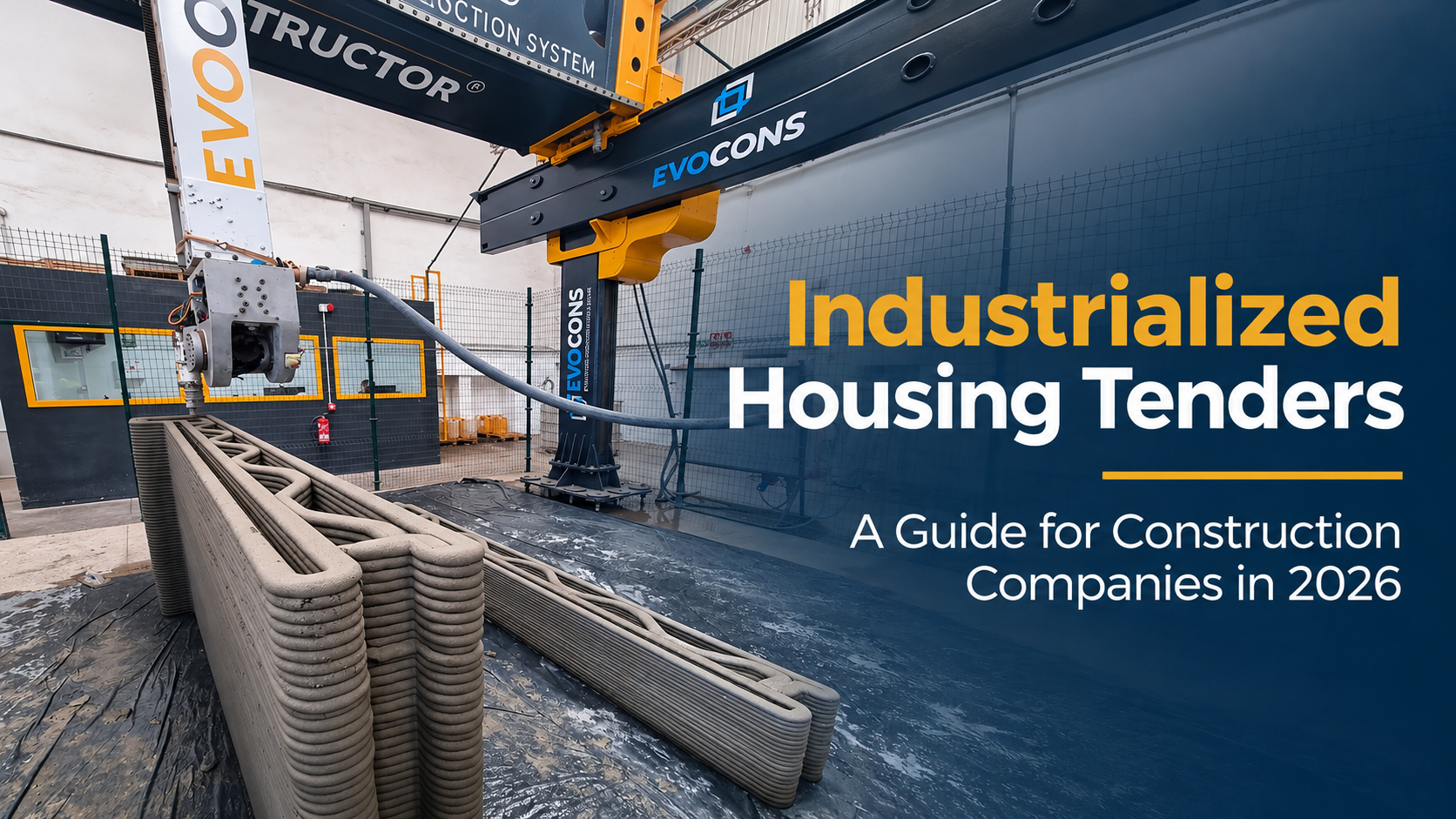
Evocons develops EvoConstructor®, a multifunctional robotic platform designed for construction automation applications, including on-site construction and prefabricated building components.
What Are Industrialized Housing Tenders?
Industrialized housing tenders are public procurement procedures through which government authorities commission residential construction projects incorporating industrialized building processes.
Industrialized construction relies on planned, repeatable and controlled production methods. These may involve prefabricated components, offsite manufacturing, modular systems or hybrid approaches combining factory production and on-site assembly.
Not all housing tenders require the same level of industrialization.
Some focus on specific building components, while others combine architectural design and construction services to improve coordination throughout the project.
For construction companies, the key is to understand the scope of each tender and identify the technical, operational and financial capabilities required to participate.
Why Is Industrialized Public Housing Growing in Spain?
Industrialized construction is gaining attention within housing policies because of its potential to improve productivity, quality control and project planning.
The European Commission has identified offsite construction as an approach that could help expand housing production capacity and support innovation in the construction sector.
In Spain, the Strategic Project for the Economic Recovery and Transformation of Housing Industrialization (PERTE) also promotes the modernization of residential construction through industrial capabilities and technological development.
These developments align with the broader transition toward Construction 5.0, where digital technologies, automation, robotics and data-driven processes support more integrated construction methods.
For construction companies, this evolution creates opportunities to collaborate with prefabrication manufacturers, technology providers, engineering teams and specialist contractors.
Industrialized Housing Tenders in Spain: Real Examples from 2026
Several Spanish public housing authorities have introduced industrialized construction approaches through different procurement models.
The following examples illustrate published tenders and announced programs during 2026. They should not be interpreted as confirmation that the bidding periods remain open.
Madrid: Industrialized Housing Tender in Vicálvaro
Madrid’s Municipal Housing and Land Company (EMVS) published procurement file 217/2025, covering architectural design and construction services for an industrialized housing development in Vicálvaro.
The contract is divided into three lots, with a combined tender value of €100,088,840.85 excluding taxes.
Published on March 6, 2026, the procurement process includes preliminary design, detailed design, construction works and complementary activities.
What can construction companies learn?
When design and construction are procured together, early coordination between architects, contractors, industrial suppliers and site managers becomes particularly important.
Manufacturing methods, logistics and construction sequences should be considered from the initial proposal.
Source: Official EMVS Madrid procurement file.
Valencia: 88 Industrialized Affordable Homes
On October 20, 2026, the Valencian Housing and Land Authority (EVHA) announced tenders for 88 industrialized affordable homes.
The developments include 52 homes in Carcaixent and 36 in Silla.
The procurement scope covers project design, technical supervision and construction.
This procurement model allows construction proposals to be assessed against the functional and industrialization requirements established in the tender documentation.
What can construction companies learn?
Contractors should assess the required level of industrialization and the technical performance criteria before choosing a particular construction system.
The ability to coordinate a complete solution may be as important as access to manufacturing technology.
Source: Official EVHA announcement.
Galicia: Expansion of Industrialized Public Housing
In March 2026, the Galician regional government announced plans to tender 392 public homes using industrialized construction techniques, representing a planned investment of €74.4 million.
These figures refer to an announced program and should not be interpreted as confirmation that every contract has already been awarded.
The initiative reflects growing interest in applying industrialized methods across public residential developments.
Galicia has also introduced industrialized construction techniques in specific building systems, including façade components.
What can construction companies learn?
Industrialization does not necessarily require a complete transformation of every construction activity.
Companies can explore the integration of industrialized components, specialized suppliers and standardized production processes within broader project delivery models.
Source: Official Galician Housing and Land Institute announcement.
Canary Islands: Industrialized Housing in Maspalomas
In April 2026, VISOCAN announced a public housing tender for a residential development in El Lomo de Maspalomas, San Bartolomé de Tirajana, Gran Canaria.
The project combines design, technical supervision and construction using partially industrialized building methods.
This approach integrates industrially manufactured components with operations performed directly on-site.
What can construction companies learn?
The value of industrialized construction should be assessed across the complete building process.
Manufacturing, transportation, installation, site coordination and finishing activities must work together to deliver the required results.
Source: VISOCAN official news and announcements.
Where to Find Industrialized Housing Tenders in Spain
Construction companies interested in industrialized public housing projects should monitor official procurement platforms and public housing authorities.
Spain’s Public Sector Procurement Platform
The Public Sector Procurement Platform provides access to public contract notices, tender documents and contracting authority profiles.
It is a useful starting point for identifying construction procurement opportunities throughout Spain.
Regional Procurement Portals
Autonomous communities and public housing organizations maintain their own procurement information and project announcements.
Monitoring these sources can help contractors identify upcoming residential developments and understand regional procurement priorities.
European Tender Portal: TED
Tenders Electronic Daily (TED) publishes public procurement notices within the European Union.
Useful search terms include:
- Industrialized housing.
- Industrialized public housing.
- Offsite construction.
- Modular housing construction.
- Prefabricated building components.
- Design-and-build housing contracts.
For Spanish tenders, searches using the equivalent Spanish terminology can help identify additional opportunities.
Companies should always consult the current procurement documents, amendments and submission deadlines before preparing an offer.
Requirements for Participating in Industrialized Housing Tenders
The requirements for industrialized housing tenders depend on the scope and conditions of each contract.
Before submitting a proposal, construction companies should evaluate five essential areas.
1. Technical and Financial Capacity
Contractors must demonstrate that they meet the financial, professional and technical capacity requirements established in the tender documents.
Spain’s Public Sector Contracts Law, Law 9/2017, regulates these conditions.
Under specified circumstances, companies may rely on the capacities of other entities, subject to applicable requirements.
2. Accepted Construction Systems
Tender documentation should define the permitted construction systems, required performance and technical conditions.
Some procurement processes allow alternative solutions, while others specify minimum industrialization requirements.
An industrialized construction tender does not automatically require 3D printing or robotic systems.
3. Manufacturing and Construction Capabilities
Contractors should explain how design, manufacturing, transportation, installation and finishing activities will be coordinated.
Industrial partners and specialist suppliers may contribute to the delivery model when permitted by the procurement conditions.
4. Quality Assurance and Technical Documentation
Companies should identify the inspections, material tests, dimensional tolerances and production records necessary to demonstrate compliance.
Clear documentation supports coordination between manufacturing and on-site execution.
5. Reliable Costs and Delivery Schedules
Financial proposals should consider the complete construction process, including preparation, production, transportation, installation and quality control.
Technical solutions must be compatible with the project’s requirements and supported by realistic operational assumptions.
How to Prepare a Competitive Industrialized Housing Tender
Preparing a competitive proposal requires a structured assessment of the construction solution and the tender’s evaluation criteria.
The following table provides a practical starting point.
| Area | What to Evaluate |
|---|---|
| Design | Compatibility with the proposed construction system |
| Manufacturing | Production capacity and expected output |
| Materials | Availability, technical specifications and testing |
| Logistics | Transportation, storage and delivery coordination |
| Quality | Inspections, tolerances and traceability |
| Scheduling | Manufacturing and construction sequence |
| Costs | Total investment and operational resources |
| Partnerships | Supplier responsibilities and available capabilities |
It is important to distinguish mandatory eligibility requirements from the evaluation criteria used to award points.
Contractors can also prepare measurable technical indicators:
- Accepted production units per period.
- Total manufacturing time per component.
- Dimensional accuracy and applicable tolerances.
- Material consumption per manufactured unit.
- Complete cost per finished component.
- Production traceability and quality records.
These indicators help compare construction alternatives and establish realistic technical commitments.
For a more detailed assessment of construction robotics investment, read our guide to construction robotics costs, implementation and ROI.
How Robotics and 3D Printing Support Industrialized Housing
Construction robotics offers opportunities to automate specific activities within industrialized building processes.
Robotic systems can be integrated into prefabrication facilities or deployed directly on construction sites, depending on their capabilities and project requirements.
3D printing can support the manufacturing of selected building components through digitally controlled material deposition.
Its suitability must be assessed in relation to geometry, material properties, quality requirements and construction logistics.
Robotics in Prefabricated Construction
Automated manufacturing processes can support the production of building components where repeatable operations and defined production sequences are appropriate.
Potential applications include the manufacturing of walls, partitions and other project-specific elements.
The production system must be coordinated with material supply, quality inspections and downstream assembly operations.
On-Site 3D Printing
On-site 3D printing allows selected building elements to be manufactured at the construction location.
Implementation requires an assessment of site access, equipment installation, material supply, environmental conditions and coordination with other activities.
Quality Assurance and Technical Standards
ISO/ASTM 52939:2023 establishes quality assurance requirements and process qualification principles for additive manufacturing in construction.
Its scope does not replace project-specific design approval or material characterization and testing requirements.
Each application must be assessed against the relevant technical specifications and regulatory framework.
Learn more in our article on automated construction technologies and applications.
EvoConstructor®: Multifunctional Robotics for Industrialized Construction
At Evocons, we develop EvoConstructor®, a multifunctional robotic platform combining robotics, advanced software, artificial intelligence and 3D printing for construction automation applications.
Its modular architecture accommodates different tools and processes, including 3D printing, concrete pouring, leveling and selected finishing operations, depending on the system configuration.
EvoConstructor® is designed for applications in on-site construction, prefabricated component manufacturing and research environments.
How Can EvoConstructor® Support Industrialized Housing Projects?
Construction companies can begin by identifying specific operations where automation could contribute to their production strategy.
A technical evaluation may include:
- Compatibility with project geometry and materials.
- Manufacturing capacity and production requirements.
- Integration with existing construction processes.
- Equipment space and installation requirements.
- Material supply and logistical planning.
- Quality assurance and validation procedures.
- Implementation and operating costs.
The objective is to determine whether robotic automation can be integrated into a technically viable and economically appropriate construction solution.
Explore EvoConstructor® and its construction applications.
The public procurement projects mentioned in this article are examples of industrialized housing initiatives. They are not presented as projects delivered by Evocons or as contracts requiring EvoConstructor®.
The Future of Industrialized Housing Tenders
Public housing developments across Spain demonstrate different approaches to industrialized construction, including integrated design-and-build contracts, prefabricated components and hybrid manufacturing methods.
For construction companies, preparing for these opportunities involves understanding procurement requirements, developing technical partnerships and evaluating production technologies using reliable data.
Robotics, digital construction and 3D printing can contribute to this transformation when their application is compatible with the project’s technical and commercial objectives.
The opportunity lies in combining construction expertise, industrial planning and innovative technology to deliver well-documented, competitive proposals.
Frequently Asked Questions About Industrialized Housing Tenders
What are industrialized housing tenders?
They are public procurement procedures for residential projects that incorporate industrialized construction systems or processes according to the tender requirements.
Where can I find industrialized housing tenders in Spain?
You can search Spain’s Public Sector Procurement Platform, regional procurement portals, public housing authority websites and the European TED portal.
What requirements must construction companies meet?
Requirements depend on each tender and may include financial standing, technical capacity, relevant classification, available resources and compliance with the contract specifications.
Can a construction company participate without owning a factory?
Depending on the tender conditions, companies may collaborate with specialized manufacturers or rely on permitted arrangements involving external capacities, subcontractors or joint ventures.
Do industrialized housing tenders require 3D printing?
Not necessarily. Industrialized construction may incorporate prefabricated components, modular systems and other manufacturing methods without using 3D printing.
How can EvoConstructor® contribute to housing projects?
EvoConstructor® can be evaluated for automating selected manufacturing or construction operations when its configuration and capabilities are compatible with the project’s requirements.
How is the ROI of construction automation calculated?
ROI can be assessed by comparing the complete investment and operating costs with measurable economic benefits over a defined period, using realistic production assumptions.
How much does it cost to introduce robotics into an industrialized housing project?
Costs depend on the equipment configuration, project scale, materials, production processes and integration requirements. A project-specific technical and financial assessment is necessary.
Explore Construction Automation with Evocons
Is your construction company evaluating new technologies for industrialized housing or prefabricated building projects?
Contact Evocons to explore EvoConstructor® capabilities and assess how multifunctional robotics could support your construction processes.