AI Adoption in Construction: From Pilots to Industrialized Execution
AI adoption in construction is accelerating and becoming a transformative force across the architecture, engineering and construction sector. However, a significant gap remains between technological potential and operational scale.
McKinsey’s analysis of the next normal in construction argues that some of the greatest productivity gains are likely to come not from isolated technological tools, but from redesigning complete workflows and connecting data, decisions and execution.
At the same time, the RICS Artificial Intelligence in Construction Report 2025, based on responses from more than 2,200 professionals worldwide, found that 45% reported no AI implementation, 34% were still in early pilot phases and only around 1% had scaled AI across projects.
Bluebeam’s AEC technology research provides another perspective. Its survey of more than 1,000 AEC technology decision-makers found that 27% of firms were using AI for automation, problem-solving or decision-making, while 94% of current users planned to expand its use.
Together, these figures point to a strategic question:
How does construction move from experimenting with AI to creating connected, repeatable and measurable production processes?
That question places AI adoption in construction within a much broader transformation: the progressive digitalization, automation and industrialization of construction.
The strategic challenge is not simply deploying AI tools. It is transforming digital intelligence into productive capacity. As AI becomes integrated into planning, coordination and decision-making, organizations increasingly need execution models capable of translating those decisions into repeatable construction outcomes.
This is where AI adoption begins to intersect with automation, robotics and industrialized construction.
AI adoption in construction: the critical gap between potential and scale
Interest in artificial intelligence is growing across architecture, engineering and construction.
But experimentation is not the same as operational adoption.
Organizations are already exploring AI for activities such as:
- Document analysis
- Design support
- Cost estimation
- Project planning
- Scheduling
- Data analysis
- Quality monitoring
- Risk assessment
- Decision support
These applications can create value individually.
However, AI adoption in construction becomes more strategically relevant when AI begins to influence complete workflows instead of remaining inside individual software tools.
The difference can be summarized as follows:
Isolated AI
Data → AI tool → recommendation
Connected adoption
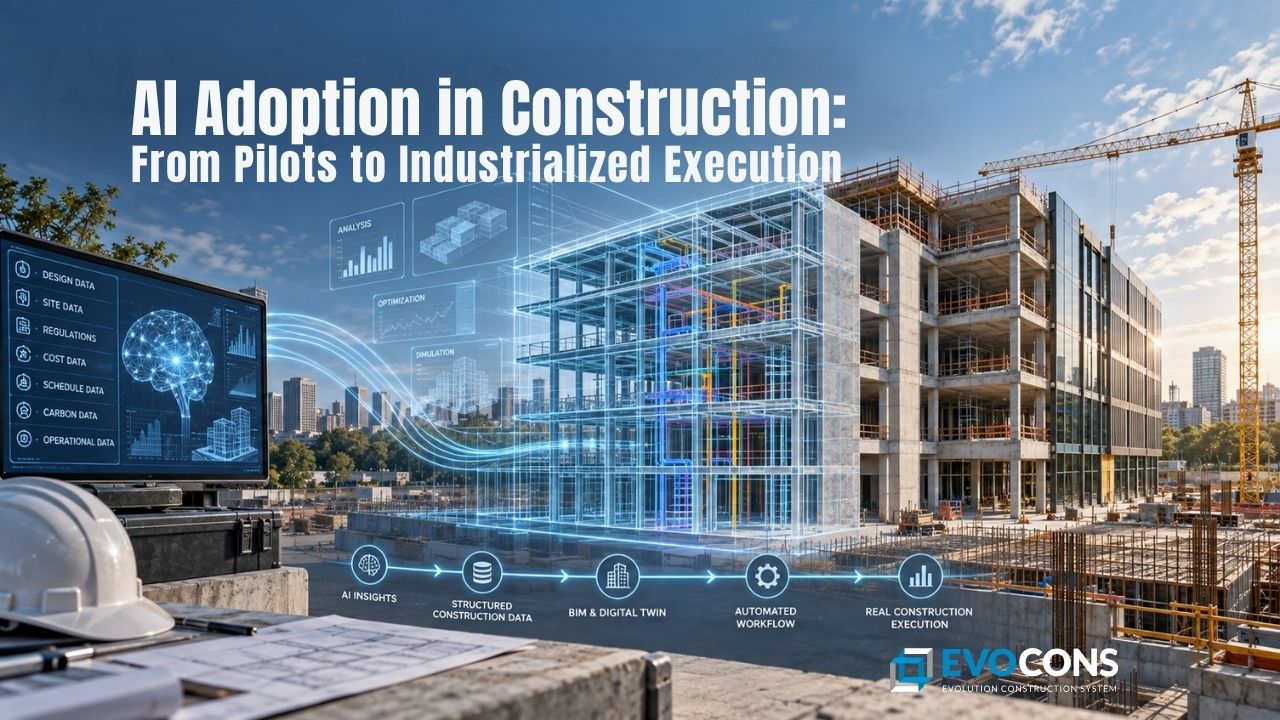
Data → AI → decision → workflow → execution → measurement → improvement
McKinsey’s construction analysis highlights the importance of redesigning end-to-end operational domains rather than accumulating isolated technology use cases.
That distinction matters because construction ultimately produces physical assets.
Digital intelligence creates greater operational value when it can connect with the processes that design, manufacture and execute those assets.
Why successful AI adoption in construction does not end with a pilot
A pilot can demonstrate that a technology works.
It does not necessarily demonstrate that the technology can become part of an organization’s normal operating model.
For AI adoption in construction to progress from experimentation to productive capacity, several conditions need to work together.
Start with a measurable process
The first question should not be:
Where can we introduce AI?
A more useful question is:
Which construction process should perform differently, and how will we measure the result?
This shifts the conversation from technology selection to operational value.
The company can then establish a baseline covering factors such as cycle time, quality, cost, process variability, material use, information flows or productive capacity.
Build around reliable information
AI systems depend on accessible and structured information.
Construction data may be distributed across:
- BIM models
- CAD files
- Schedules
- Specifications
- Cost systems
- Production records
- Quality documentation
- Site information
- Equipment data
The RICS Artificial Intelligence in Construction Report 2025 identifies data quality and system integration among the important factors influencing adoption.
The value of an AI recommendation therefore depends partly on whether the information surrounding the process can support it.
Connect technology with professional expertise
AI can analyse information, detect patterns, generate alternatives and support decisions.
Construction professionals provide context, technical judgment, validation and responsibility.
Effective AI adoption in construction should strengthen this relationship.
The objective is not to separate technology from professional knowledge. It is to make knowledge easier to apply, measure, document and reuse.
Construction AI implementation: integration matters more than the number of tools
A strong construction AI implementation strategy is not necessarily the one with the largest technology stack.
The more important question is whether the technologies work together.
Bluebeam’s research on AEC technology reinforces this point by highlighting the importance of integration, digital collaboration, connected data and governance in the evolution of construction workflows.
A construction organization may use excellent systems for design, scheduling, cost control and execution.
If information must continually be transferred manually between them, the workflow remains fragmented.
A more integrated model creates continuity between:
Design → planning → production information → execution → quality control → feedback
AI implementation is therefore increasingly connected with broader construction automation strategies that integrate robotics, software, BIM, sensors and physical execution.
This is why construction AI implementation increasingly overlaps with digital transformation and industrialization.
The objective moves from automating isolated decisions to creating an operating system in which information can move efficiently through the construction process.
From AI adoption in construction to powerful industrialized execution
The next stage is larger than artificial intelligence itself.
Industrialized construction applies principles that are familiar in other productive sectors:
- Repeatable processes
- Digital production information
- Standardized procedures
- Automated operations
- Prefabrication
- Modular production
- Traceability
- Data-based quality control
- Continuous improvement
This makes the relationship with AI adoption in construction increasingly important.
AI can analyse.
Software can coordinate.
Automation can execute.
Digital manufacturing can translate geometry into production instructions.
Robotics can transform those instructions into physical operations.
When these capabilities are connected, construction begins to operate less like a succession of disconnected activities and more like an integrated production system.
EVOCONS examines this transition in greater depth in its analysis of industrialized construction and the evolution of construction automation.
The https://single-market-economy.ec.europa.eu/sectors/construction/construction-transition-pathway_en identifies digitalization, BIM, data sharing, standardization and new production models as important components of a more resilient and competitive construction ecosystem.
The European Commission has also placed off-site construction, AI-supported design and robotics within the skills and technology transformation expected across the construction ecosystem.
The direction is significant:
Digitalization, automation and industrialized construction are increasingly becoming parts of the same productive transformation.
Spain is accelerating the move towards industrialized construction
Spain provides another important signal.
In April 2025, the Spanish Government announced a €1.3 billion public investment over ten years through the https://www.lamoncloa.gob.es/presidente/actividades/Paginas/2025/240425-perte-industrializacion-vivienda.aspx.
The initiative explicitly connects housing industrialization with digitalization, productive capacity, sustainability and new industrial solutions.
This means industrialization is no longer only a technological conversation.
It is increasingly connected with:
- Investment
- Manufacturing capacity
- Digital infrastructure
- Automation
- New production models
- Standards
- Professional development
- Scalable construction systems
For technology providers, contractors, developers and prefabricated manufacturers, the strategic opportunity is therefore not simply to adopt individual technologies.
It is to develop the infrastructure through which construction can become progressively more connected, repeatable and measurable.
AI construction workflows need to reach physical execution
Many current AI applications operate primarily around information.
They analyse.
Compare.
Predict.
Generate.
Classify.
Recommend.
But a building is a physical product.
Eventually, digital information needs to influence execution.
This makes AI construction workflows an important area for the next stage of adoption.
Consider a simplified workflow:
Digital model → process planning → parameters → robotic instructions → execution → monitoring → data
Each stage creates information for the next.
Execution can then generate new data that returns to supervision, quality control and future planning.
This creates a feedback loop:
Plan → execute → measure → learn → optimize
For AI adoption in construction, this connection is strategically important because it moves AI closer to productive capacity.
The question changes from:
What information can AI generate?
to:
How can that information become part of a controlled construction process?
Construction robotics: connecting digital instructions with physical operations
https://evocons.com/construction-robotics/ provides one possible execution layer for digital workflows.
Software can organize information.
AI can support interpretation and optimization.
A robotic system can transform programmed instructions into physical movements.
Applications already being developed across construction include:
- 3D printing
- Material deposition
- Concrete pouring
- Levelling
- Milling
- Drilling
- Finishing
- Inspection
- Monitoring
Organizations evaluating this execution layer can explore EVOCONS’ detailed analysis of https://evocons.com/construction-robotics/.
The strategic value of construction robotics does not come only from automating movement.
It comes from the possibility of connecting digital design, process parameters, execution and measurement.
This turns the robotic system into part of a larger digital workflow rather than an isolated machine.
Why multifunctionality is a powerful advantage for AI adoption in construction
Automation can be implemented through different architectures.
A company may use specialized equipment dedicated to individual processes.
Another approach is a multifunctional platform capable of supporting several operations through a common robotic and digital infrastructure.
Both strategies can be appropriate.
The difference becomes important when the company wants to expand automation progressively.
A specialized system might follow:
Process A → dedicated machine
A multifunctional strategy can evolve through:
Process A → validation → Process B → new tool → new product → expanded utilization
This creates a different investment logic.
The organization is not only acquiring equipment for one task. It is building productive infrastructure capable of supporting additional applications.
For AI adoption in construction, this matters because a common platform can provide a more coherent environment for connecting digital information, programming, execution and operational data.
For a deeper analysis of this model, EVOCONS explores how a https://evocons.com/multifunctional-construction-robot/ can expand automation beyond a single construction task.
Evoconstructor® and the transformative transition towards industrialized execution
This broader transformation provides the context for Evoconstructor®.
Evoconstructor® is a pioneering multifunctional construction robot developed by EVOCONS around the integration of software, robotics, artificial intelligence and 3D printing.
Unlike single-purpose systems, Evoconstructor® combines artificial intelligence, robotics, digital manufacturing and a modular Plug & Play tool architecture within the same platform.
Its patented architecture incorporates a Z-axis, a robotic arm and a self-elevating system. This exclusive configuration enables the system to access construction areas and automate multiple phases through a common infrastructure, supporting progressive industrialization across different project environments.
Its architecture supports different construction operations, including:
- 3D printing of construction elements
- Concrete pumping and pouring
- Automated concrete levelling
- Interchangeable robotic tools
- Rendering, tiling, milling and polishing
- Automated vertical progression
The strategic relevance is not simply that several functions can be performed.
It is that multiple operations can be considered within a common robotic and digital architecture.
For AI adoption in construction to extend beyond digital analysis, companies need an execution layer capable of transforming programmed information into physical operations.
Evoconstructor® addresses this direction by connecting digital production with robotized execution.
EVOCONS develops the platform for different operating environments, including on-site construction and prefabricated construction.
For manufacturers assessing how this model can evolve inside a production environment, EVOCONS also examines how a https://evocons.com/robotic-platform-prefabrication/ can expand products and processes.
This approach is particularly relevant for manufacturers looking to expand both products and processes through flexible robotic infrastructure.
This versatility is particularly relevant to industrialization because industrialized production does not have to follow a single model.
It can include:
- Automated on-site processes
- Off-site manufacturing
- Prefabrication
- Digital fabrication
- Hybrid workflows combining factory and site operations
Evoconstructor® can therefore be evaluated not simply as a 3D-printing system, but as a multifunctional infrastructure for progressively automating construction processes.
From isolated automation to a scalable industrialized operating model
The evolution can be understood through three levels.
Digital assistance
AI supports individual information tasks.
Strategic result: faster analysis and decision support.
Process automation
Software or equipment automates an operation.
Strategic result: more repeatable execution.
Industrialized execution
Data, software and automation connect across workflows.
Strategic result: expandable productive capability.
The third stage is where AI adoption in construction becomes particularly relevant to industrialization.
Not every activity needs to be automated.
Nor does every process need to use AI.
The opportunity lies in creating continuity between:
Design → planning → data → execution → quality → feedback
This approach aligns with the principles of https://evocons.com/construction-5-0/, where digital technologies, automation and professional expertise operate within connected production systems.
Within EVOCONS, Construction 5.0 provides the broader framework for combining advanced technologies with sustainability, resilience and professional knowledge rather than treating automation as an isolated objective.
The essential roadmap for AI adoption in construction
Effective AI adoption in construction should begin with the workflow rather than the technology.
1. Identify the process
Select an operation or sequence with clear strategic relevance.
Define what should improve and why.
2. Establish the baseline
Measure the current process before introducing new technology.
Relevant indicators may include:
- Cycle time
- Quality
- Cost
- Process variability
- Material utilization
- Data availability
- Rework
- Productive capacity
3. Define the digital inputs
Identify the information required to operate the workflow.
This could include BIM, CAD, production parameters, schedules or operational records.
4. Define the role of AI
Determine whether AI should:
- Analyse
- Predict
- Detect
- Generate
- Optimize
- Coordinate
- Support decisions
5. Connect the execution layer
Define what happens after the digital decision.
The output may lead to:
- Professional validation
- Software instructions
- Production planning
- Automated equipment
- Robotic execution
This stage is critical for AI adoption in construction because it determines whether digital intelligence remains informational or becomes operational.
Organizations evaluating this stage can use EVOCONS’ guide to https://evocons.com/automated-construction-technologies/ to examine how digital information connects with programmable equipment and execution.
6. Validate through a measurable pilot
The pilot should test the complete workflow.
Its objective is not merely to prove that an algorithm or machine functions.
It should demonstrate whether the process creates measurable value.
Beyond technical validation, organizations should also evaluate operational and economic impact.
Measuring productivity improvements, process stability and return on investment helps determine whether a pilot can evolve into a scalable capability.
EVOCONS explores these variables in its analysis of https://evocons.com/construction-robotics-roi/.
7. Expand reusable capabilities
After validation, identify which components can support additional applications.
These may include:
- Data structures
- Software connections
- Robotic tools
- Production procedures
- Training
- Quality criteria
This is how construction technology can move from a pilot to a scalable industrial capability.
How to measure AI adoption in construction effectively
The number of AI licenses does not measure operational adoption.
Neither does the number of experiments.
Organizations should evaluate AI adoption in construction using indicators connected with actual workflows.
Relevant measures can include:
- Percentage of projects using the workflow
- Frequency of use
- Number of connected processes
- Reduction in manual data transfers
- Time across the complete workflow
- Quality and repeatability
- Number of decisions supported
- Percentage of outputs connected with execution
- Utilization of automated infrastructure
- Additional applications developed after the first pilot
- Return compared with the initial baseline
These indicators distinguish experimentation from productive adoption.
They also help organizations decide where further integration creates the greatest value.
The powerful next stage of AI adoption in construction is connected execution
The construction sector is unlikely to industrialize through a single technology.
AI can strengthen analysis and decision-making.
BIM can structure project information.
Software can coordinate workflows.
Digital manufacturing can translate geometry into production data.
Construction robotics can transform instructions into physical operations.
Prefabrication can provide controlled industrial production environments.
Professional expertise connects these capabilities and gives them technical context.
The strategic opportunity appears when they become parts of the same operating model.
For EVOCONS, this evolution reinforces the broader value proposition behind Evoconstructor®.
The platform is not limited to printing walls.
Its multifunctional architecture creates a technological foundation through which several construction operations can be programmed, automated and progressively integrated.
That is one of the central opportunities for AI adoption in construction:
Moving from isolated digital intelligence towards connected, measurable and industrialized execution.
Frequently asked questions about AI adoption in construction
What is AI adoption in construction?
AI adoption in construction means integrating artificial intelligence into real workflows rather than limiting its use to isolated experiments. Applications may include planning, design, document analysis, quality control, monitoring and connected production processes.
Why is AI adoption in construction still at an early stage?
Research from the RICS Artificial Intelligence in Construction Report 2025 indicates that many organizations remain in exploration or pilot phases. Integration, data quality, implementation planning and clearly defined use cases influence how quickly AI becomes part of normal operations.
What is construction AI implementation?
Construction AI implementation is the process of integrating AI into a defined workflow, including its data inputs, professional responsibilities, software connections, validation criteria and operational outputs.
What are AI construction workflows?
AI construction workflows connect artificial intelligence with other stages of the construction process. They can link project data, analysis, decisions, planning, execution and measurement.
How does AI support industrialized construction?
AI can support analysis, optimization and decision-making. Industrialized construction emerges when these capabilities are connected with repeatable production processes, digital manufacturing, automation and quality control.
What is the relationship between AI and construction robotics?
Construction robotics can provide a physical execution layer for digital instructions. AI may support analysis or optimization, while robotic systems execute programmed operations.
Why are multifunctional construction robots relevant?
A multifunctional platform can support several operations through a common technological infrastructure. This can allow companies to validate one process and progressively expand automation to additional applications.
How does Evoconstructor® fit this trend?
Evoconstructor® combines software, robotics, AI, 3D printing and interchangeable tools within a multifunctional construction platform. Its applications include both on-site and prefabricated construction.
How should a company begin AI adoption in construction?
Start with a clearly defined workflow, establish measurable baseline data, identify the information required, validate a pilot and determine which digital and physical capabilities can be reused across additional applications.
From AI potential to measurable productive capacity
The question is no longer simply whether artificial intelligence will influence construction.
The more strategic question is:
How can digital intelligence become part of a repeatable, measurable and executable construction process?
Successful AI adoption in construction will increasingly depend on the ability to connect data, professional expertise, software, automation and physical execution.
EVOCONS operates at this intersection through Evoconstructor® and the development of multifunctional robotics for industrialized construction.
Explore how Evoconstructor® connects artificial intelligence, robotics and automated construction workflows to support powerful, scalable and industrialized execution.
Contact EVOCONS to identify which construction processes can become part of your strategic automation roadmap.