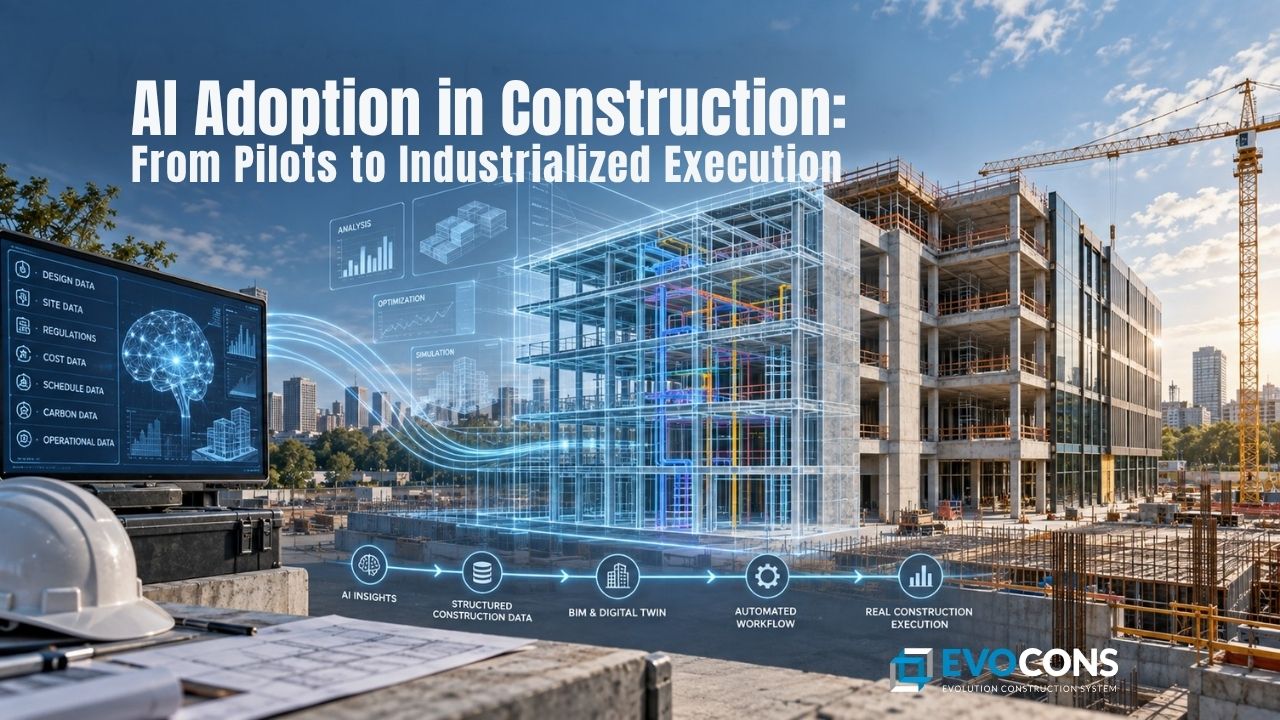
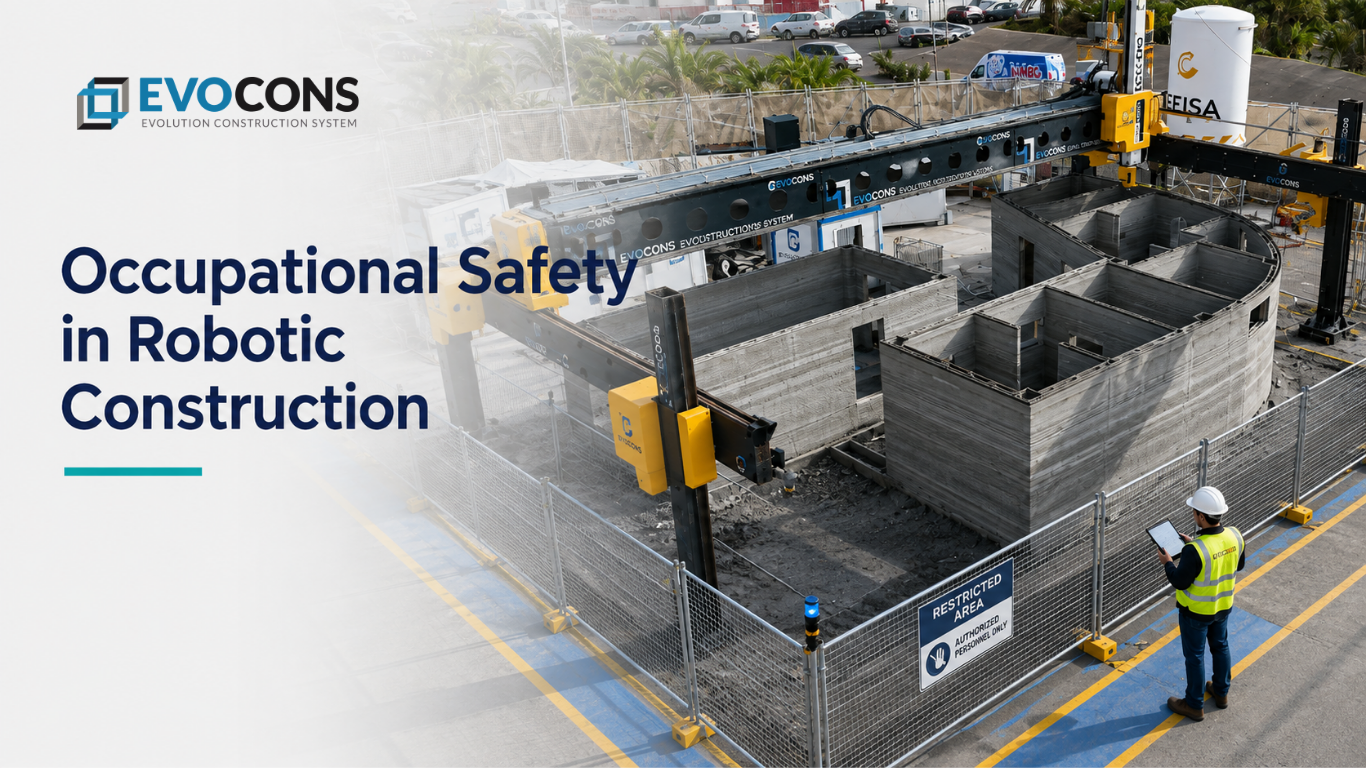
Construction robotics is evolving from the automation of individual tasks towards the integration of complete construction processes.
3D printing, layout, drilling, material handling, finishing, inspection and monitoring are among the applications already being developed for construction sites and prefabrication facilities.
The most significant change is not simply the introduction of a robot into a project. It is the connection of digital design, planning, execution and quality control through a continuous flow of information.
A systematic review published in the Journal of Intelligent & Robotic Systems identifies environmental perception, mobility, manipulation and human–robot collaboration as central capabilities in the development of construction robotics.
The study also highlights technological integration and adaptation to changing environments as important factors for wider implementation.
What is construction robotics?
Construction robotics refers to programmable systems capable of performing, assisting or supervising activities related to the manufacture, construction, inspection and maintenance of buildings and infrastructure.
These systems may use information from:
- Building Information Modelling models.
- Computer-aided design files.
- Computer-aided manufacturing applications.
- Sensors and cameras.
- Laser scanners.
- Planning platforms.
- Analysis and control algorithms.
A construction robot does not need to be fully autonomous.
Many systems operate within semi-automated workflows under the planning and supervision of architects, engineers, technicians and materials specialists.
Their contribution lies in converting digital instructions into repeatable and documentable physical movements. Their value increases when design, execution and control data remain connected throughout the process.
From task automation to process automation
Traditional automation generally focuses on a clearly defined task, such as drilling, printing, painting, transporting or inspecting.
This approach can be highly effective when the operation is stable and repetitive. However, construction projects consist of multiple interdependent activities.
When each activity uses a different machine and software system, additional transitions appear between equipment, formats and project stages. Some of the efficiency achieved within one operation can be lost during those transitions.
Robotic construction introduces a more integrated workflow:
- The component or building is digitally designed.
- The digital model is reviewed and validated.
- Software converts the geometry into machine instructions.
- Toolpaths and operating parameters are calculated.
- The robot performs the operation.
- Sensors capture process information.
- The outcome is compared with predefined criteria.
- The data is used to document and improve the process.
A bibliometric review of 212 scientific publications, covering research published between 2002 and 2024, shows that the field is moving towards modular robots, autonomous navigation, collaboration between professionals and robotic systems, and greater integration of digital disciplines.
The transformation therefore depends on more than the mechanical capabilities of a robot. It also depends on the quality of the digital model, software interoperability and process planning.
Technologies enabling robotic construction
BIM as an information foundation
Building Information Modelling structures geometric, technical and operational information within a shared digital model.
In a robotic workflow, BIM can provide information about positions, dimensions, sequences and relationships between components. It can also support comparisons between the planned design and the completed work.
BIM does not necessarily control the robot directly. It acts as an information layer that can connect design data with planning and manufacturing tools.
CAD/CAM and toolpath generation
Computer-aided design software is used to define geometry. Computer-aided manufacturing systems convert that geometry into manufacturing instructions.
These instructions may include:
- Toolpaths.
- Speeds.
- Orientations.
- Material flow rates.
- Operational sequences.
- Tool changes.
- Control points.
Machine accuracy alone cannot compensate for an error in the geometry or planning process. Digital preparation is therefore a fundamental part of construction automation.
Sensors and perception systems
Cameras, force sensors, scanners and LiDAR systems allow a robot to collect information about its surroundings.
This data can be used to locate components, recognise obstacles, verify positions or adjust operating parameters.
A review of artificial intelligence in on-site construction robotics examined 319 publications through a “sense, think, act” framework.
The authors identify system robustness, data standardisation and the integration of construction-specific knowledge as priority areas for future development.
Artificial intelligence
Artificial intelligence can support environmental recognition, object classification, movement planning and data analysis.
Not every construction robot uses AI. Many systems operate through programmed instructions and conventional control systems.
AI becomes relevant when a robot needs to interpret complex information or adapt to variable conditions. Its use should be supported by appropriate validation, supervision and control procedures.
Additive manufacturing
Additive manufacturing produces components by depositing material in a controlled manner, generally layer by layer.
In construction, it can be used to produce:
- Walls and enclosures.
- Formwork.
- Moulds.
- Prefabricated components.
- Urban furniture.
- Customised geometries.
The ISO/ASTM 52939:2023 standard for additive manufacturing in construction establishes quality assurance requirements for building and infrastructure projects using additive manufacturing processes.
It covers relevant process characteristics, manufacturing-cell operations and project sequences. It does not replace structural codes, materials validation or the local regulations applicable to each project.
Applications of robotics in construction
On-site 3D printing
Robotic 3D printing deposits material along a digitally calculated path.
It can support the manufacture of variable geometries and reduce the need for certain moulds or formwork systems. Designs can also be modified digitally without completely rebuilding the physical production setup.
However, the final result depends on several factors:
- Material behaviour.
- Component geometry.
- Stability during deposition.
- Bonding between layers.
- Environmental conditions.
- Structural strategy.
- Integration of reinforcement and building services.
- Subsequent operations.
Printing one part of a building does not mean that the entire construction process has been automated.
Robotic prefabrication
Prefabrication facilities offer favourable conditions for automation because the workspace, materials and production sequences can be controlled more consistently.
Robotics may be applied to:
- Mould and formwork manufacturing.
- Production of customised components.
- Dosing and material deposition.
- Component handling.
- Drilling and milling.
- Surface treatments.
- Dimensional inspection.
- Identification and traceability.
The bibliometric review published in Applied Sciences identifies the integration of robotics, prefabrication and modular construction as an emerging area of development.
This approach may support flexible production lines capable of manufacturing different geometries using the same infrastructure.
Layout and drilling
Mobile robots can transfer information from the digital model to the physical site through marking, positioning or drilling.
These applications reduce intermediate steps between design and execution. They can also record the location of each operation for later verification.
Pouring and levelling
Robotic platforms can control pumping, pouring, deposition or levelling paths.
Repeatability is particularly valuable when uniform sequences are required. However, material properties and environmental conditions remain important variables.
Automated finishing
Some robotic systems can incorporate tools for:
- Rendering.
- Sanding.
- Polishing.
- Milling.
- Painting.
- Insulation application.
- Installation of selected finishes.
Finishing operations present a particular challenge because the robot must work on surfaces whose tolerances and conditions may vary during construction.
Inspection and monitoring
Robots equipped with cameras, sensors or scanners can move through a construction site and collect information about its progress.
The data can be compared with the digital model to identify deviations and support technical decision-making.
These applications can provide value without physically altering the constructed element.
Specialised robots and multifunctional robots
Specialised robots are designed to perform one primary operation. Multifunctional robots can integrate several tools or configurations within the same platform.
| Criterion | Specialised robot | Multifunctional robot |
|---|---|---|
| Function | One defined operation | Several operations |
| Configuration | Optimised for one task | Modular and adaptable |
| Process change | Requires different equipment | May use a tool change |
| Integration | Focused on the task | Focused on the overall workflow |
| Main advantage | High task-specific performance | Continuity between stages |
| Suitable use | Stable, repetitive processes | Variable or integrated processes |
Neither approach is universally superior.
A specialised robot may be the most suitable option for a high-volume repetitive operation. A multifunctional platform may provide greater value when an organisation wants to connect different construction stages or use the same infrastructure across several project types.
What defines a multifunctional construction robot?
Multifunctionality involves more than adding accessories to a machine.
To integrate several operations, the platform must coordinate different tools, movements, parameters, data sources and control systems.
Interchangeable tools
The same structure can change its function by using different heads or modules.
This may allow the platform to deposit material, machine surfaces, apply coatings or perform finishing operations, provided that each process has been technically validated.
Shared software environment
Different functions can be managed through a common digital layer.
This reduces the need to rebuild geometry and planning data every time the tool changes.
Information continuity
Several operations can use data from the same digital model.
This continuity supports traceability and allows the results of one stage to be related to the parameters used in previous stages.
Adaptation to different environments
A modular architecture can be configured for on-site construction or prefabrication facilities.
However, the two environments require different operating models. Logistics, access, maintenance and process organisation must be assessed separately.
Evoconstructor® as an example of a multifunctional robot
Evoconstructor® is a platform developed by EVOCONS to integrate several construction operations within the same robotic system.
It is presented here as an example of the shift towards multifunctionality, rather than as a universal solution or the only technological approach available.
According to the technical information published by EVOCONS, the platform combines software, robotics, additive manufacturing and modular tools.
Potential applications include:
- 3D printing.
- Concrete pouring.
- Levelling.
- Selected finishing operations.
- Progressive construction at height.
- On-site construction.
- Prefabricated production.
Automation beyond 3D printing
A conventional construction 3D printer primarily focuses on material deposition.
The Evoconstructor® approach uses a common structure to incorporate additional operations. Its conceptual difference lies in the scope of the process it is designed to automate, rather than only its printing speed or dimensions.
The technical description of the multifunctional construction robot includes tools for printing, concrete pouring and levelling, machining and selected finishing operations.
These capabilities must be configured and validated according to the project and the material being used.
Modular architecture
Evoconstructor® uses interchangeable tools.
This configuration allows the same robotic infrastructure to support different operations. Its economic suitability will depend on tool-change times, equipment utilisation, project volume and production variety.
Self-elevating system
Evoconstructor® incorporates a system designed to move with the vertical development of the building.
This feature is intended to expand the working area beyond the platform’s initial fixed reach.
Its practical application must be assessed according to project geometry, stability, planning and site conditions.
On-site and prefabrication applications
The platform is designed for both on-site construction and prefabricated production.
Using a modular technological architecture in both environments can support the transfer of geometries, toolpaths and methodologies.
However, an industrial production plant and an open construction site require different configurations and operating models.
Use in a real construction project
EVOCONS used Evoconstructor® in a 126.45-square-metre project in Agüimes, Gran Canaria.
In its public presentation of the ECOAGA project, the company states that more than 60% of the construction process included within the project scope was automated.
This percentage should be interpreted as a result reported by EVOCONS for a specific case.
It is not a guaranteed figure for every building, since it depends on the activities included, the project type, design, materials and the methodology used to calculate the level of automation.
Potential benefits of robotic construction
Repeatability
A robot can reproduce programmed toolpaths and operating parameters.
Repeatability does not remove the need for control. Calibration, material behaviour and environmental conditions can still affect the result.
Traceability
Digital systems can record instructions, configurations, operating times and incidents.
This information can be used to document the process and compare the completed work with the original plan.
Integration between design and execution
Using a shared digital source reduces repeated interpretations of the project geometry between stages.
The benefit depends on the accuracy of the model and its ability to exchange information with planning and control systems.
Geometric flexibility
Robotic manufacturing can produce variable shapes without creating an entirely new mould for every component.
This is particularly relevant for customised prefabricated elements, short production runs, façades and components with complex geometries.
Controlled material use
Programmed deposition can adjust material distribution to the geometry and defined parameters.
Any reduction in material consumption, waste or emissions should be measured through a transparent methodology and attributed only to the project analysed.
Continuous improvement
Digital processes generate reusable information.
Toolpaths, parameters and results can be used to improve later projects, provided the data is recorded and analysed in a structured manner.
How to evaluate a robotic construction implementation
The assessment should begin with the process to be improved, rather than with the selection of a machine.
Define the use case
The organisation should determine:
- Which operation it wants to automate.
- Which result it wants to improve.
- The expected work volume.
- The level of project variation.
- The required accuracy.
- How results will be measured.
Analyse the complete workflow
Automating one operation does not automatically improve the overall process.
The analysis should include preparation, material supply, configuration, execution, control, maintenance and subsequent activities.
Establish a baseline
Before launching a pilot project, it is useful to measure:
- Time per unit.
- Cost per operation.
- Material consumption.
- Number of adjustments.
- Achieved tolerances.
- Incidents.
- Setup time.
- Annual capacity.
Without a baseline, it is not possible to calculate the return on automation rigorously.
Review digital integration
The robot needs reliable information.
The organisation should review data formats, BIM models, CAD/CAM tools, production systems and traceability mechanisms.
Validate through a pilot project
A pilot makes it possible to evaluate performance before expanding the implementation.
It should reproduce conditions that are sufficiently close to real operations and use previously defined indicators.
Challenges of construction robotics
Variable environments
A manufacturing facility can be organised around stable conditions. A construction site changes as the project progresses.
The robotic system must respond to changes in access, surfaces, geometry and environmental conditions.
Interoperability
Design, planning and control applications do not always use compatible formats.
A lack of continuity between systems can limit the benefits of automation.
Material behaviour
In printing and robotic deposition, the material must perform consistently during pumping, extrusion, placement and curing.
Materials engineering and robotic planning should therefore be developed together.
Quality assurance
ISO/ASTM 52939:2023 provides a quality-assurance framework for additive manufacturing in construction.
However, each project must still comply with the relevant structural standards, building codes and local requirements.
Scalability
A result achieved in a prototype does not guarantee identical performance in a larger project.
Scaling requires a new assessment of materials, supply, logistics, maintenance, equipment reach and coordination with other operations.
Robotics and Construction 5.0
Construction 5.0 can be understood as the application of Industry 5.0 principles to the built environment.
The European Commission defines Industry 5.0 around three pillars:
- Human-centricity.
- Sustainability.
- Resilience.
This framework complements technological efficiency with wider industrial and social objectives.
From this perspective, robotics is not an end in itself. Its purpose is to support construction processes that are more measurable, adaptable and coordinated.
Collaboration between professionals and robotic systems can combine:
- Construction expertise.
- Design capabilities.
- Programmed precision.
- Execution data.
- Quality control.
- Learning between projects.
The future of robotic construction
The sector is unlikely to be dominated by a single machine capable of performing every task.
It is more likely to develop through connected ecosystems involving specialised robots, multifunctional platforms, sensors, BIM models and data-analysis systems.
Artificial intelligence may improve environmental perception, planning and adaptation.
However, research continues to identify robustness, interoperability, data quality and reliable operation under variable conditions as key areas for development.
The success of a robotic implementation will not depend solely on the machine. It will also depend on:
- The quality of the digital design.
- Selection of the right use case.
- Material preparation.
- Team training.
- Integration with other processes.
- Definition of performance indicators.
- Validation of results.
Conclusion
Construction robotics is already being applied to 3D printing, prefabrication, layout, drilling, handling, finishing, inspection and monitoring.
Its main contribution is not simply the automation of physical movements. It is the ability to connect design, planning, execution and control through digital information.
Specialised robots will continue to provide value in repetitive and clearly defined operations. Multifunctional robots represent an evolution towards integrating several stages and reducing transitions between different machines.
Evoconstructor® illustrates this second approach through a modular architecture, interchangeable tools, a self-elevating system and potential applications in both on-site construction and prefabrication.
As with any industrial technology, its results should be evaluated using verifiable data, clearly defined operating conditions and comparisons with an established baseline.
Robotic construction will progress when it is assessed through the quality, traceability and usefulness of the processes it enables, not only through the novelty of the machine.
Frequently asked questions
What is construction robotics?
Construction robotics is the use of programmable systems to perform, assist or supervise manufacturing, construction, inspection and maintenance operations.
What tasks can a construction robot perform?
It may support 3D printing, layout, drilling, material handling, pouring, levelling, finishing, transport, inspection and monitoring.
How are BIM and robotics connected?
BIM can provide geometric and operational information for planning toolpaths, coordinating operations and comparing completed work with the intended model.
What is the difference between a 3D printer and a multifunctional robot?
A 3D printer primarily deposits material. A multifunctional robot can incorporate different tools and perform several operations using the same platform.
What are the benefits of construction robotics?
Potential benefits include improved repeatability, traceability, geometric control, digital integration and the ability to manufacture customised components.
What differentiates Evoconstructor®?
Its approach combines 3D printing with additional operations, interchangeable tools, a self-elevating system and potential applications in both on-site and prefabricated construction.
Does robotic construction guarantee lower costs?
Not automatically. The outcome depends on production volume, the use case, equipment utilisation, materials, integration and logistics.